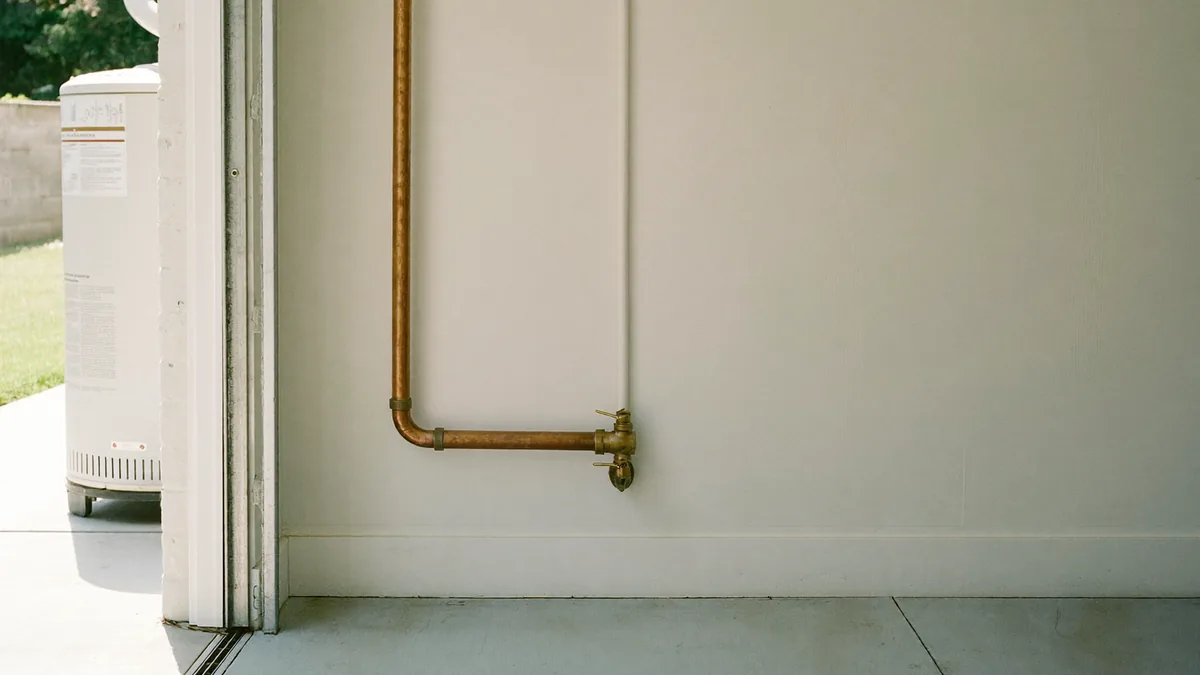
A water heater relief valve, often called a T&P valve, is a safety device that opens to release hot water when the tank's pressure or temperature climbs past a safe point. It protects the tank from rupturing. If it drips or discharges steadily, the cause is usually excess pressure, thermal expansion, high temperature, or a worn valve.
What the water heater relief valve does
The valve is mounted on the tank, usually on the top or side. It has a spring-loaded seat and a sensing element that reaches into the hot water, so it responds to both pressure and temperature. When either one passes its set limit, the valve opens and lets water escape through a discharge pipe to a safe location.
A tank that overheats or builds too much pressure can fail in a serious way. The valve is the automatic backstop for those conditions. It is not meant to handle normal operation, so frequent discharge is a sign that something upstream needs attention.
Why a water heater relief valve discharges
A discharge is a symptom. Four causes account for most cases, and each one points to a different fix.
Thermal expansion in a closed system
Water expands as it heats. In a home where a check valve, backflow preventer, or pressure-reducing valve stops water from flowing back out to the street, the expanding water has nowhere to go. Pressure climbs inside the tank, and the valve may release a little water during heating cycles, even when no one is running a faucet. A thermal expansion tank is a common remedy, but whether you need one depends on local rules, so check with your local building department.
Excess supply pressure
If the incoming water pressure is high, the tank sees that pressure too. A pressure-reducing valve on the main line may have failed or been set too high. Have the supply pressure measured rather than guessing, because the fix depends on what the gauge shows.
High water temperature
If the thermostat lets the tank run above its normal range, the temperature side of the valve opens. The U.S. Department of Energy recommends setting water heaters to 120°F, which it describes as a temperature considered safe for most of the population. A dial set much higher, or a faulty thermostat, can push the tank into discharge territory.
A worn or clogged valve
Sediment and mineral scale build up in the tank and around the valve seat. Grit can keep the valve from sealing, so water seeps out even when pressure and temperature are normal. Valves also wear with age. According to the U.S. Department of Energy, most storage (tank) water heaters last 10 to 15 years, so an older tank is more likely to have a worn valve.
Is a small drip from the water heater relief valve normal?
Some valves weep a few drops while the tank heats, especially when the water is close to its set point. A steady drip, a stream, or water that keeps coming after you close the valve is not normal. Treat that as a sign that pressure, temperature, or the valve itself needs attention.
Look at the pattern as well as the amount. Water that appears only during heating cycles points toward expansion or pressure. Water that appears at random times, with no change in household use, more often points toward the valve or debris in the seat.
How to test a water heater relief valve safely
Safety first: The water from a discharge pipe can scald, so stand to one side and keep hands and feet clear of the outlet. On an electric heater, turn off the breaker and confirm there is no power with a voltage tester before you touch the access panel or wiring. On a gas heater, set the gas control to pilot or off as the label directs. If you smell gas, leave the home and call the gas utility or 911 from outside. The Consumer Product Safety Commission notes that third-degree burns can occur from water at 150°F in about 2 seconds.
Follow these steps to check the valve without taking anything apart:
- Confirm the discharge pipe is attached, open at the end, and directed toward a floor drain or an approved outdoor location. Do not add caps or fittings.
- Stand clear of the pipe end and confirm the path to the drain is free of objects.
- Lift the test lever gently and hold it until water flows steadily. Do not force the lever past its stop.
- Release the lever. The valve should snap closed and the flow should stop completely.
- Watch the discharge pipe for several minutes. Continued dripping suggests debris on the seat or a worn valve.
- If no water comes out at all, the lever may be stuck or the outlet blocked. Stop and do not repeat the test with more force.
- After the test, check the valve body and the pipe for drips and for white or rust-colored crust. Crust suggests past discharges even if the valve seems fine now.
Test the valve only when you have a reason to, such as a visible leak or a change in the discharge pattern. Repeated lifting can wear the seat and cause the very leak you are trying to diagnose.
Why a water heater relief valve must never be capped or plugged
The valve is the only automatic release for dangerous pressure or temperature. Capping it, plugging the outlet, or running the discharge pipe into a dead end removes that release. Pressure and heat can then build inside the tank until a part fails, and the tank can rupture.
Some people plug the valve to stop a drip. The drip is the warning. Find out what is causing it, and replace a valve that cannot seal. The same rule applies to the discharge pipe itself. Adding a valve, a tee, or a threaded end creates a point where the path can be closed or clogged.
Water heater relief valve discharge pipe basics
The discharge pipe carries the valve's output to a safe place. The International Code Council summarizes these requirements from the International Plumbing Code (section 504.6) and the International Residential Code (section P2804.6.1), 2021 editions:
- It must not connect directly to the drainage system.
- It must end in an air gap in the same room as the water heater.
- It must be no smaller than the valve outlet.
- It must not be trapped, and it must drain by gravity.
- Its end must be no more than 6 inches above the floor or a waste receptor.
- Its end must not be threaded.
- It must have no valves or tees.
- It must be rated for 100 psi at 180°F.
These are model code provisions. Adoption and amendments vary by state and city, so check with your local building department before you change the pipe. A pipe that looks correct can still fail an inspection if local rules differ.
How to keep a water heater relief valve from discharging repeatedly
- Set the thermostat to 120°F. The U.S. Department of Energy calls that a temperature considered safe for most of the population. According to the same source, people with a compromised immune system or chronic respiratory disease may want to keep the tank at 140°F, in which case you should temper water at the fixtures.
- Flush the tank periodically to remove sediment, following the manufacturer's instructions for your model.
- Have the supply pressure checked, and ask about a pressure-reducing valve if the reading is high.
- Ask whether your plumbing layout needs a thermal expansion tank, and confirm the requirement with your local building department.
- Replace a valve that keeps weeping after testing or that shows heavy mineral crust. Replace it rather than plugging it.
- Keep the discharge pipe clear, free of kinks, and sloped so it drains by gravity.
Plan ahead for age. Because most tank water heaters last 10 to 15 years, a valve on an older unit deserves closer attention, and the tank itself may be near the end of its life.
Finding someone to fix the valve
When a valve keeps discharging after these checks, get at least two written quotes. Check each contractor's license with the state licensing board where licensing applies. Ask who pulls the permit, whether the work will be inspected, and what the quote includes, such as haul-away of the old unit, any code upgrades needed for the discharge pipe, and warranty registration for a replacement tank.
Frequently asked questions
Can I cap the water heater relief valve to stop the drip?
No. Capping or plugging the valve removes its only automatic release for excess pressure or temperature inside the tank. The drip is the warning sign. Find the cause, such as excess pressure, thermal expansion, high temperature, or a worn seat, and replace the valve if it cannot seal properly. Never cap the outlet or add valves to the discharge line.
Is it normal for the valve to drip a little?
A few drops during a heating cycle can happen, particularly when the water is near its set point. Continuous dripping, a stream, or water that appears after the valve closes is not normal. Test the valve gently, note the pattern, and look for crust or pipe damage. If the discharge continues, treat it as a problem to correct rather than a quirk to live with.
What temperature should I set my water heater to?
The U.S. Department of Energy recommends 120°F, which it describes as a temperature considered safe for most of the population. People with a compromised immune system or chronic respiratory disease may want 140°F, according to the same source. At higher settings, use tempering at the fixtures to reduce scald risk, and avoid setting the thermostat above what your household needs.
Can I replace the valve myself?
Some homeowners do this work, but it involves draining the tank, handling pipe threads, and sometimes working around electric or gas controls. Turn off power or gas first and confirm it is off. Check with your local building department whether a permit is required. If you are unsure about any step, hire a pro and ask for the permit and inspection to be handled as part of the job.
Does every water heater need a thermal expansion tank?
Not every system needs one, and the answer depends on the plumbing layout and local requirements. A thermal expansion tank is often considered when a check valve, backflow preventer, or pressure-reducing valve keeps water from flowing back to the street. Ask your local building department what applies in your area, and ask a pro to evaluate your specific system before you buy or install anything.