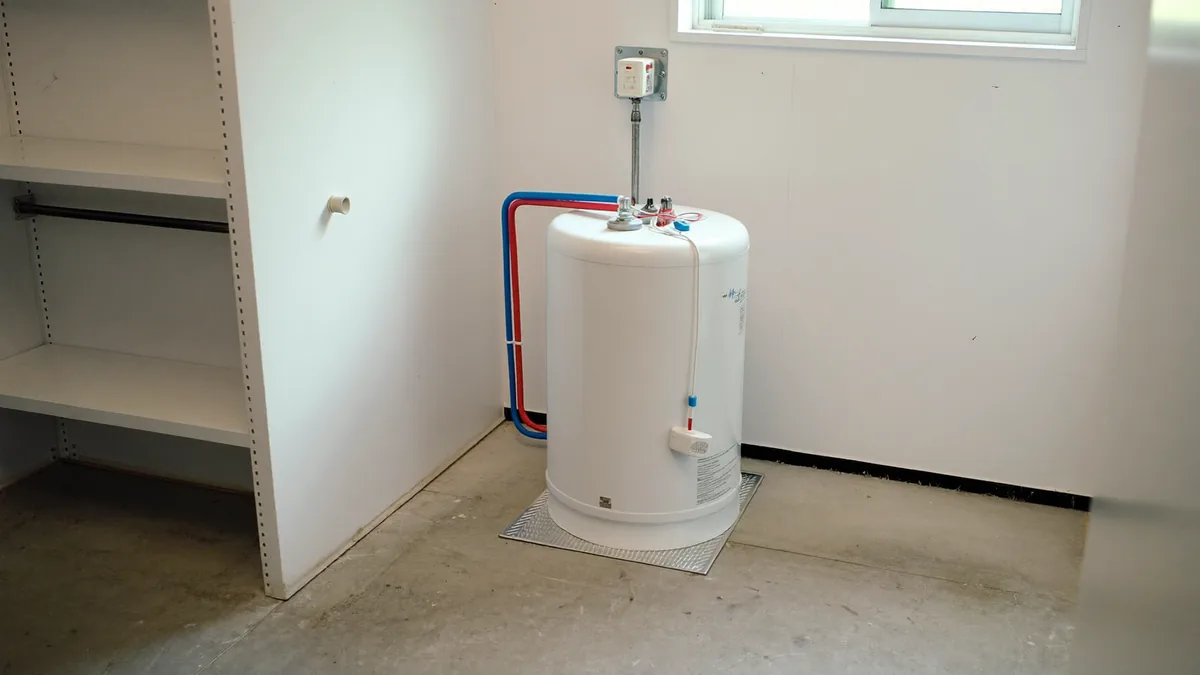
A proper water heater installation includes a permit and inspection, safe removal of the old unit, correct water, gas or electrical connections, a temperature and pressure (T&P) relief valve with a compliant discharge pipe, an expansion control where the plumbing needs one, correct venting, seismic strapping where required, and startup checks.
What a complete water heater installation covers
A replacement is more than swapping one tank for another. A good installer checks the location, fuel type, water supply, venting or wiring, and discharge path before ordering a unit. The job should end with a unit that matches the household's hot water needs and passes inspection.
Expect the work to follow a clear sequence: plan and permit, shut off utilities, remove the old unit, set and connect the new one, test, and inspect. If a quote skips any of these steps, ask how the installer plans to handle it.
Permits and inspection
Many jurisdictions require a plumbing permit to install or replace a water heater. For example, the City of San Diego states that a plumbing permit is required for the installation of a water heater, including replacements. Requirements vary by state and city, so check with your local building department before work begins.
Ask who pulls the permit. Where homeowners are allowed to pull their own permits, you take on the scheduling, the inspection, and the paperwork. When a contractor pulls it, the contractor is responsible to the inspector. Either way, keep the permit number and the inspection sign-off with your home records.
Removing and disposing of the old unit
Removal starts with shutting off the power or gas and the cold water supply. The installer then drains the tank through a hose to a suitable drain or outdoor spot, opens a hot tap so air can enter and water can flow out, and disconnects the flue, water lines, and any electrical or gas connections.
A full tank is heavy, so removal often takes two people and a hand truck. Confirm in writing whether haul-away and disposal are included. Many quotes leave this out, and you may be charged separately for hauling the old unit away.
Water connections
The cold supply should feed the unit through a shutoff valve so the tank can be serviced later without shutting off the whole house. The hot outlet should connect to the distribution piping with fittings rated for the water temperature and pressure in your system.
Installers often use dielectric fittings or unions where copper meets steel to slow corrosion at the joint. Once the lines are connected, the installer should open the cold supply and check every fitting for drips before the unit is energized or fired.
Gas and electrical connections
Safety first: If you smell gas at any point, leave the home and call the gas utility or 911 from outside. Do not operate light switches, appliances, or phones inside. For electrical work, turn off the breaker, then use a tester to confirm the circuit is dead before you touch any wires.
Gas units
A gas water heater needs a gas line sized for its input rating, an accessible shutoff valve, and a connector approved for gas appliances. The installer should test every joint for leaks using a soap solution or a method suited to the piping, and should never test with an open flame.
Electric units
An electric unit needs its own dedicated circuit with a breaker and wire size that match the nameplate rating. The installer should confirm the grounding connection and check that the wiring is secured in the junction box with the cover in place.
The T&P relief valve and discharge pipe
The temperature and pressure relief valve protects the tank if temperature or pressure climbs beyond safe limits. Its discharge pipe carries hot water safely away from people and property. The International Code Council's 2021 editions of the International Plumbing Code (504.6) and International Residential Code (P2804.6.1) set the rules for that pipe.
According to those codes, the discharge pipe must:
- Not connect directly to the drainage system, and end in an air gap in the same room
- Be no smaller than the valve outlet and must not be trapped
- Drain by gravity and end no more than 6 inches above the floor or a waste receptor
- Have no threaded end, valves, or tees
- Be rated for 100 psi at 180°F
A T&P relief valve must never be capped or plugged. Common mistakes include running the discharge pipe up or into a trap, using a smaller pipe to save space, and sharing one pipe with another device. Check the valve's operation and the discharge path at startup, and ask the installer to show you where the water will go if the valve opens.
Expansion control
Water expands as it heats. In a closed plumbing system, such as one with a check valve or a pressure-reducing valve on the supply, that expansion has nowhere to go and can raise pressure in the tank. An expansion tank gives the water room to expand and reduces stress on the tank, fittings, and T&P valve.
Whether an expansion tank is required depends on your plumbing and local code. Ask the installer to explain whether your system is closed, and whether the local code calls for an expansion control. If the answer is unclear, check with your local building department.
Venting and combustion air for gas units
A gas unit must vent exhaust gases outdoors through a flue sized and installed for that appliance. The vent should rise continuously away from the unit, the connections should be fastened with screws, and the vent should terminate at the correct location outside the home. The unit also needs enough combustion air, which is often supplied from the room or through openings to outdoors.
The CPSC recommends carbon monoxide alarms on every level of the home and outside sleeping areas. Test the alarms after the install, and replace them when the manufacturer's end-of-life date arrives.
Garage and location clearances
If the unit sits in a garage, the ignition source matters. The International Residential Code (P2801.7 and M1307.3) requires the ignition source of appliances in garages to be at least 18 inches above the floor, a rule the North Carolina State Fire Marshal cites. Some states have exceptions, and North Carolina has exempted electric water heaters since 2024.
Gas water heaters made after July 1, 2003 with FVIR (flammable vapor ignition resistant) construction resist igniting flammable vapors, according to the CPSC. Still, check with your local building department about garage rules before you choose a location, because the answer depends on where you live.
Seismic strapping where required
In California, Health and Safety Code section 19211 requires water heaters to be anchored or strapped so they resist falling or moving in an earthquake. Sellers must also certify to buyers that the water heater is braced, according to Cal OES. Strapping should be fastened to framing rather than drywall, and the installer should show you how it is secured.
Other areas may have their own requirements, so check with your local building department rather than assuming strapping is optional.
Startup checks
Before you turn the unit on, the installer should confirm the tank is full of water. Then the installer should light the gas burner or energize the electric elements according to the manufacturer's instructions, and watch for leaks at every joint.
Set the thermostat to 120°F. According to the U.S. Department of Energy, 120°F is a temperature considered safe for most of the population. The CPSC notes that third-degree burns can occur after about 2 seconds at 150°F, 6 seconds at 140°F, 30 seconds at 130°F, and can occur after 5 minutes at 120°F. The DOE says people with a compromised immune system or chronic respiratory disease may want to keep the setting at 140°F, so discuss that with your doctor if it applies to you.
Ask the installer to explain the unit's First-Hour Rating, Maximum GPM (for tankless units), and Uniform Energy Factor on the label. Those ratings describe how much hot water the unit supplies and how efficiently it operates, so they help you judge whether the unit fits your household's use.
How to vet an installer
- Get at least two written quotes that list the same scope: model class, removal, connections, discharge piping, expansion control, strapping where required, permit, and startup.
- Check the contractor's license with your state licensing board where licensing applies. Confirm the license is active and that the company name on the quote matches the name on the license.
- Ask about permits: whether the contractor pulls them, what inspections are required, and whether the final inspection is completed before you pay in full.
- Ask for a certificate of liability insurance and proof of workers' compensation coverage.
- Ask what is included: haul-away of the old unit, code upgrades such as new discharge piping or breakers, and warranty registration with the manufacturer.
The metro-area directory on this site can help you find local companies to compare, but you still need to verify each one using the steps above. A low price with missing items often costs more later.
When replacement makes more sense
According to the U.S. Department of Energy, most storage (tank) water heaters last 10 to 15 years, while tankless water heaters can last more than 20 years. If your current tank is near the end of that range and shows leaks, rust at the base, or repeated repairs, a replacement install is often the practical choice.
Frequently asked questions
Do I always need a permit for a water heater installation?
Many jurisdictions require a plumbing permit to install or replace a water heater, including replacements. The City of San Diego is one example. Rules differ by state and city, so ask your local building department whether your project needs a permit and an inspection.
How long should a new water heater last?
According to the U.S. Department of Energy, most storage (tank) water heaters last 10 to 15 years, while tankless water heaters can last more than 20 years. Actual life depends on water quality, maintenance, and installation quality, so a correct install is one of the best ways to reach the longer end of that range.
Why does the T&P discharge pipe have to end near the floor?
The International Residential Code requires the discharge pipe to end no more than 6 inches above the floor or a waste receptor, so any water released is visible and can drain safely. The pipe must also be unthreaded, free of valves and tees, and not trapped, and it must never be capped or plugged.
Can I install a water heater in my garage?
Often yes, but the rules depend on location and fuel type. The International Residential Code requires the ignition source of garage appliances to be at least 18 inches above the floor, and some states allow exceptions. Check with your local building department before you choose the spot.
What should I ask an installer before signing a contract?
Ask for a written quote that lists permit handling, removal and haul-away, connections, discharge piping, expansion control, strapping where required, and startup checks. Confirm the license with your state licensing board where licensing applies, and ask for proof of liability insurance before work begins.