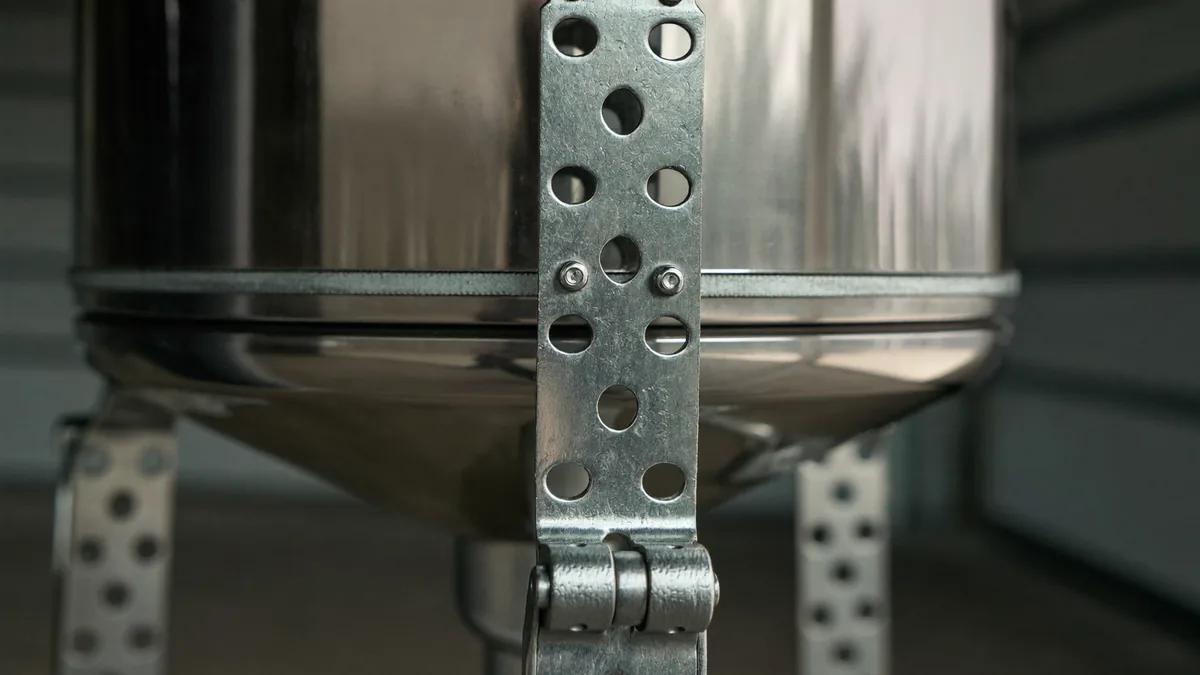
Water heater earthquake straps are metal bands that hold a tank against a wall so it cannot tip, slide or tear its water and gas connections during shaking. In California, state law requires water heaters to be anchored or strapped to resist falling or moving in an earthquake, and sellers must certify that the unit is braced. Elsewhere, the rules depend on state and local codes, so check before you assume you are covered.
Why a water heater needs to be secured
A water heater is heavy when full, and it stands on a small footprint. During shaking, an unsecured tank can rock, walk off its base or fall over. That motion can break the water lines, pull the gas connection loose or damage the flue, and a broken gas line is a fire hazard.
Strapping does not stop the shaking. It limits how far the tank can move, which keeps the connections intact and the unit upright. The strap itself is simple hardware, but it only works when it is fastened to solid framing and sized and placed correctly.
Where water heater earthquake straps are required
California
California Health and Safety Code section 19211 requires water heaters to be anchored or strapped to resist falling or moving in an earthquake. The same section requires sellers to certify to buyers that the water heater is braced. The California Governor's Office of Emergency Services (Cal OES) summarizes this requirement, so you can read the summary on its official site if you want the plain-language version.
The requirement applies to the unit itself, not just to new installations. If you are buying or selling a home in California, ask the seller or agent for the bracing certification, and confirm that the straps you see are fastened to the wall and not just resting on the tank.
Other states and cities
Outside California, the rules vary. Some states and cities adopt seismic provisions in their building codes, while others do not address water heater bracing at all. Your local building department can tell you what applies to your address and whether a permit is needed.
Permits are a separate question. Many jurisdictions require a plumbing permit to install or replace a water heater. For example, the City of San Diego states that a plumbing permit is required for the installation of a water heater, including replacements. Ask who pulls the permit, whether the inspection covers strapping, and whether a replacement triggers any upgrade to the strapping or venting.
How water heater seismic straps are placed in general terms
Strap placement depends on the tank size, the style of water heater and the wall construction, so treat the following as a general outline. Follow the instructions that come with your strap kit, and follow your local code where it is more specific.
- Use two straps when possible. One strap is usually placed around the upper part of the tank and one around the lower part, so the unit is held at two points.
- Fasten into framing. Screws or bolts should go into wall studs or solid blocking, not only into drywall or paneling, which can pull out under load.
- Keep the strap snug. The strap should wrap the tank firmly with little slack, but it should not pinch or dent the shell.
- Clear the controls. Keep straps away from the gas valve, thermostat, drain valve, burner access and electrical connections so you can still service the unit.
- Leave the relief valve alone. The temperature and pressure relief valve must never be capped or plugged, and no strap should block it or its discharge pipe.
- Respect the discharge pipe rules. Under the International Plumbing Code 504.6 and International Residential Code P2804.6.1 (2021 editions, as summarized by the International Code Council), the discharge pipe must not be connected directly to the drainage system, must end in an air gap in the same room, must not be smaller than the valve outlet and must not be trapped. It must drain by gravity, end no more than 6 inches above the floor or a waste receptor, have no threaded end and contain no valves or tees. Make sure a strap does not force the pipe into a trap or a threaded fitting.
If the water heater sits in a garage, the International Residential Code (P2801.7 and M1307.3) requires the ignition source of appliances in garages to be at least 18 inches above the floor, as cited by the North Carolina State Fire Marshal. Some states have exceptions, and North Carolina has exempted electric water heaters since 2024. Confirm the rule for your state before you move or raise a unit.
Check your existing straps
Many older water heaters have no straps at all, and some have straps that were installed loosely or fastened to nothing solid. A few minutes of inspection will show you what you have.
- Look at the tank from the front and the sides. Confirm that at least one strap, and ideally two, wraps the tank and is not just resting on it.
- Push firmly on the top of the tank. It should not walk, rock or shift on its base. Any movement is a sign the strap is loose or missing.
- Check each fastener. Screws should be tight and seated in wood framing, not in loose drywall or hollow spaces.
- Look for rust, cracks, bent metal or stripped holes in the strap and its brackets.
- Check the connections. Water lines and the gas line should have some flexibility, and they should not be stretched or touching the wall.
- Confirm the relief valve and its discharge pipe are unobstructed and not capped.
Safety first
Turn off the electrical breaker that feeds an electric water heater and confirm the power is off with a voltage tester before you touch wiring or controls. For a gas unit, do not work on the gas valve or burner area while the unit is running, and never use a flame to look for leaks. If you smell gas, leave the home immediately and call the gas utility or 911 from outside.
Installing or replacing straps
- Choose a strap kit sized for your tank and read its instructions. Make sure it includes the fasteners recommended for wood framing.
- Locate the wall studs with a stud finder and mark them. Confirm that the mounting points will sit on solid framing.
- Shut off the power or gas supply to the unit before you work near controls or connections.
- Position the upper strap around the tank, clear of the controls, and attach it to the stud. Tighten it until it holds the tank without deforming it.
- Position the lower strap in the same way, and fasten it to the wall framing.
- Push on the tank again to confirm it stays put. Restore power or gas, then check for leaks at every connection.
Common mistakes to avoid
- Screwing the strap into drywall only, where it can pull out in shaking.
- Wrapping the strap around the gas line or water piping, which can stress the connections.
- Placing a strap over the relief valve or the handle of the gas valve.
- Using a strap that is too loose to hold the tank, or so tight that it bends the shell.
- Assuming an old strap is still secure after a move or a nearby renovation.
When to call a professional
Call a professional if you need to move the water heater, change the gas line or venting, replace the unit, or discover that the wall framing will not hold a strap. Also call if the tank has visible damage, a leak at the base, or a connection you are not comfortable working on.
When you look for help, get at least two written quotes that list the same work. Check the contractor's license with the state licensing board where licensing applies, and ask whether the price includes permits, who pulls them, haul-away of the old unit, any code upgrades and whether the warranty requires registration.
Frequently asked questions
Are water heater earthquake straps required everywhere?
No. California Health and Safety Code section 19211 requires water heaters to be anchored or strapped to resist falling or moving in an earthquake, and it requires sellers to certify that the unit is braced. Other states and cities set their own rules, and some do not address bracing directly. Ask your local building department what applies at your address.
Do I need a permit to add straps to an existing water heater?
It depends on your jurisdiction. Many places require a plumbing permit to install or replace a water heater, and the City of San Diego requires one for installation, including replacements. Simply adding straps to a unit that is already in place may not need the same permit, but you should confirm with your building department before you start.
Can I strap a water heater myself?
Many homeowners can mount a strap kit if they are comfortable with basic tools, can find solid framing and can shut off power or gas safely. The harder parts are gas connections, venting and any change to the relief valve or discharge pipe. If the job involves those, bring in a professional.
Where should the straps attach on the wall?
Straps should fasten into wall studs or solid blocking, not only into drywall or paneling. The upper and lower straps should sit at different heights on the tank so the unit is held at two points. Follow the strap kit instructions for the exact fastener type and spacing.
Can a strap block the relief valve or its discharge pipe?
It should not. The temperature and pressure relief valve must never be capped or plugged, and the discharge pipe must keep its required path, including the air gap, the height limit and the absence of valves or traps. Keep the strap clear of both, and check that the pipe still drains freely after you finish.
Does strapping affect my home insurance or the sale of my home?
In California, a seller must certify that the water heater is braced, so a missing strap can become a problem during a sale. Insurance rules differ by company and policy, so ask your insurer directly whether bracing matters for your coverage.