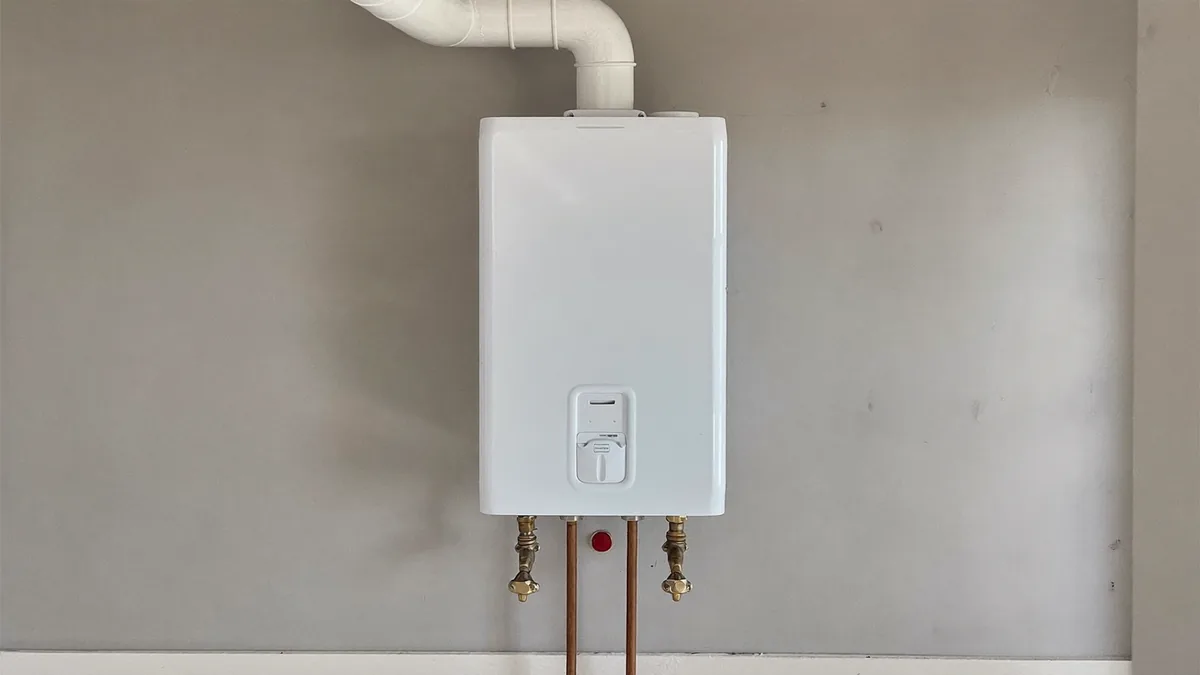
A tankless water heater heats water only when you open a tap or shower, instead of keeping a full tank hot. It uses a gas burner or electric heating elements to warm water as it flows through the unit. It can outlast a tank model and suits some homes well, but it costs more up front and has a limited flow rate.
How a tankless water heater works
A tankless unit, sometimes called an on demand water heater, has no storage tank. When a hot water fixture opens, cold water flows into the unit, a flow sensor detects the movement, and the burner or elements switch on. The water passes through a heat exchanger and leaves at your set temperature.
Because the water is heated as it moves, the unit can supply hot water for as long as the flow continues. The limit is how fast it can heat water, not how much water it holds. That is why flow rate matters more here than tank size does with a storage model.
Gas vs electric tankless units
Gas tankless units use a burner fed by a gas line. They generally produce more heat per hour than electric units, which makes them the common choice for larger households or homes that run several fixtures at once. They need venting, and the gas supply must be able to deliver the burner's demand.
Electric tankless units need no exhaust vent, which simplifies placement. They draw a large amount of electrical current while heating, so many homes need electrical service evaluated before installation. An electrician can tell you whether your panel and wiring can handle the load.
For efficiency, compare the UEF (Uniform Energy Factor) on each unit's label. The UEF is the federal measure of a water heater's overall efficiency. According to ENERGY STAR, the minimum UEF for gas tankless water heaters is 0.95.
Flow rate and temperature rise
Two numbers shape how a tankless unit performs in your home. The first is its maximum flow rate, the Maximum GPM from the federal test procedure, which is the most hot water in gallons per minute the unit can supply. The second is temperature rise, the amount the unit must heat incoming water to reach your set temperature.
Cold incoming water needs more heating, so temperature rise is largest in winter, when the groundwater supplying your home is coldest. A unit rated for a certain flow at a mild incoming temperature may deliver less in January. Setting the outlet temperature higher also reduces the flow the unit can deliver at that setting.
Federal maximum flow rates for new fixtures help you estimate demand. According to the DOE (10 CFR 430.32), showerheads are limited to 2.5 gallons per minute at 80 psi, and lavatory and kitchen faucets to 2.2 gallons per minute at 60 psi. Two showers running together can therefore call for up to 5 gallons per minute.
To check whether a unit fits your home:
- List every hot water fixture and appliance that runs at the same time during your busiest period, such as morning showers plus a dishwasher.
- Add their flow rates. Use the federal caps for fixtures you have not measured.
- Ask the installer for the unit's flow at the incoming water temperature you get in your coldest month, not just the catalog maximum.
- Compare the total with that figure. If your total is above it, plan for a larger unit, a second unit, or staggered use.
Venting and installation needs
Gas tankless units need a vent to carry combustion gases outside. Designs vary, including direct-vent and power-vent systems, and some high-efficiency models also produce condensate that must drain properly. Vent length and routing often decide where the unit can be placed, so ask the installer to confirm the route before you buy.
Installation often costs more than a like-for-like tank swap. A gas tankless unit may require a larger gas line or meter capacity, a new vent, and a new electrical circuit for its controls. An electric unit may need a service upgrade instead. Get each item listed separately on written quotes so you can compare them.
Safety first: If you smell gas, leave the home and call the gas utility or 911 from outside. Do not operate switches or appliances while you are inside. For electrical work, turn off the breaker at the panel and verify the circuit is dead with a tester before touching wires. The CPSC recommends carbon monoxide alarms on every level of the home and outside sleeping areas, and that applies to any gas-fired water heater.
Maintenance and descaling
In areas with hard water, minerals build up inside the heat exchanger as the water is heated. Scale reduces heat transfer, cuts flow, and can cause the unit to shut down or show an error code. Descaling is the routine cleaning that removes these deposits, and it is the main maintenance task for most tankless units.
Many units have service valves and a port for flushing with a descaling solution. Follow the manufacturer's maintenance schedule and instructions for your model. Many homeowners have a qualified pro perform the flush, especially on gas units, because the work involves the gas and water connections.
You can keep the unit working well with a few simple checks:
- Clean the inlet water filter screen as the manual directs, since sediment can restrict flow.
- Note any drop in hot water flow at your usual fixtures, which often signals scale.
- Record any error codes and the date they appeared, and give that record to the technician.
- Check that the vent termination outside is clear of leaves, snow, and debris.
- Keep a log of service visits and descaling so warranty requirements are easy to meet.
Tankless water heater pros and cons
Pros
- Long life: According to the U.S. Department of Energy (DOE), tankless water heaters can last more than 20 years, while most storage tank water heaters last 10 to 15 years.
- No standby heat loss: Because no tank stays hot all day, the unit uses energy only while water flows.
- Space savings: Units are compact and often mount on a wall, which frees floor space in a utility closet or garage.
- Steady hot water: Within its flow and temperature limits, the supply does not run out after a long shower.
- Efficiency standards: ENERGY STAR sets minimum efficiency levels, so you can compare units on a common scale.
Cons
- Higher upfront cost: Equipment and installation usually cost more than a tank replacement, and the added work for gas or electrical upgrades can widen the gap.
- Flow limits: Heavy simultaneous demand can exceed the unit's Maximum GPM, especially in winter.
- Maintenance: Hard water requires regular descaling, and skipped maintenance can shorten the unit's useful life.
- Venting and utility needs: Gas units need a vent and adequate gas supply, and electric units may need service upgrades.
- Wait for hot water: A fixture far from the unit can take a while to deliver hot water, and small flows may not activate the burner at all.
Is a tankless water heater worth it?
A tankless unit is worth it when its longer life, lower standby losses, and space benefits outweigh a higher installed cost for your household. The DOE says water heating is about 18% of a home's energy use, so efficiency gains affect only part of your bill. Savings depend on how much hot water you use and how efficiently the current heater runs.
To test the decision against your own home:
- Estimate your peak simultaneous hot water use, using the method in the flow rate section.
- Get at least two written quotes that list the unit, venting or electrical work, gas line work, permits, and removal of the old heater.
- Compare each quote's total cost against the expected service life of each option, using the DOE figures above.
- Check whether your current water heater is near the end of its life, since a failing tank may make the timing decision for you.
- Look up incentives, as described below, before you decide.
Who a tankless water heater suits
- Small households or couples whose peak hot water use is modest and predictable.
- Homes with a gas supply and venting path that can support a gas unit without major upgrades.
- Owners who plan to stay in the home long enough to benefit from a longer service life.
- Homes with a bathroom or kitchen far from the existing tank, where point-of-use placement may help.
- Owners with soft water or a water treatment system, which reduces scale buildup.
Who should think twice
- Large households that regularly run two or more showers, a dishwasher, and laundry at once.
- Homes with hard water and no plan for regular descaling.
- Homes where the gas line, meter, or electrical service would need major upgrades.
- Renters who cannot approve venting or electrical changes with the landlord.
- Households that need the lowest possible upfront cost right after a tank fails.
Incentives and efficiency rules
Federal tax credits have changed, so check current rules before you decide. According to the IRS, the 25C Energy Efficient Home Improvement Credit applied only to property placed in service before December 31, 2025, so it does not apply to 2026 installations. The 25D Residential Clean Energy Credit, which covered 30% including solar water heaters, is not available for property placed in service after December 31, 2025.
Home Electrification and Appliance Rebates (HEAR) are run by states and available only in select states. They offer up to $1,750 for an ENERGY STAR heat pump water heater, for households with income below 150% of area median income. Since DOE Program Notice 26-2 (effective May 29, 2026), these rebates no longer cover replacing a gas (non-electric) appliance, so they do not cover a gas tankless replacement.
DOE efficiency standards have applied since April 16, 2015. A DOE rule for gas tankless water heaters published in December 2024 was withdrawn by Congress under the Congressional Review Act on May 20, 2025. Confirm current programs with your state energy office, your utility, and the official IRS and DOE websites.
Temperature settings and scalding
The DOE recommends setting a water heater to 120°F, a temperature it considers safe for most of the population. The CPSC notes that third-degree burns can occur after about 2 seconds at 150°F, 6 seconds at 140°F, 30 seconds at 130°F, and can occur after 5 minutes at 120°F. Anyone who cannot react quickly, including young children and older adults, is at higher risk.
According to the DOE Energy Saver Guide, people with a compromised immune system or chronic respiratory disease may want to keep the water heater at 140°F. The DOE's facilities guidance notes that Legionella bacteria can grow in water heaters under certain conditions, and it recommends a tempering (mixing) valve set to 120°F downstream of storage tanks. A tankless unit has no storage tank, so ask your installer how they plan to manage temperature and Legionella risk in your specific layout.
Finding a pro
Get at least two written quotes that describe the same scope of work, so you can compare equipment, venting, gas or electrical upgrades, and permit fees. Check the contractor's license with your state licensing board where licensing applies. Ask who pulls the permits, since that determines who answers for inspections, and check with your local building department on venting and electrical requirements, which vary by state and city. Ask what is included, such as haul-away of the old unit, any code upgrades, and warranty registration.
Frequently asked questions
Is a tankless water heater worth it for a small household?
It can be, if your hot water use is modest and your home can support the unit without major upgrades. Compare the total installed cost of each quote with the longer service life the DOE cites for tankless units. Also check how often you would need descaling in your water. A small household with soft water and a suitable gas or electrical setup often has the best case for a tankless unit.
How long does a tankless water heater last compared with a tank?
According to the U.S. Department of Energy, tankless water heaters can last more than 20 years. Most storage tank water heaters last 10 to 15 years. Actual life depends on water quality, maintenance, and installation, so regular descaling and a correct vent or electrical setup help the unit reach its expected life.
Can a tankless water heater run two showers at once?
Some units can, if their Maximum GPM covers the combined flow at your coldest incoming water temperature. Federal caps limit new showerheads to 2.5 gallons per minute at 80 psi, so two showers can call for up to 5 gallons per minute. Check the unit's rated flow at winter temperatures before assuming it will meet that demand.
Do I still get tax credits for a tankless water heater in 2026?
Probably not from the federal government. The 25C credit applied only to property placed in service before December 31, 2025, and the 25D credit is not available after that date. Check the IRS website and your state energy office for any current state or utility programs, since HEAR rebates do not cover replacing a gas appliance.
What maintenance does a tankless water heater need?
Most units need periodic descaling, especially where water is hard, along with cleaning the inlet filter and checking the vent outside. Follow the manufacturer's schedule and record any error codes or drops in flow. Keeping service records helps with warranty claims and tells a technician what has already been done.