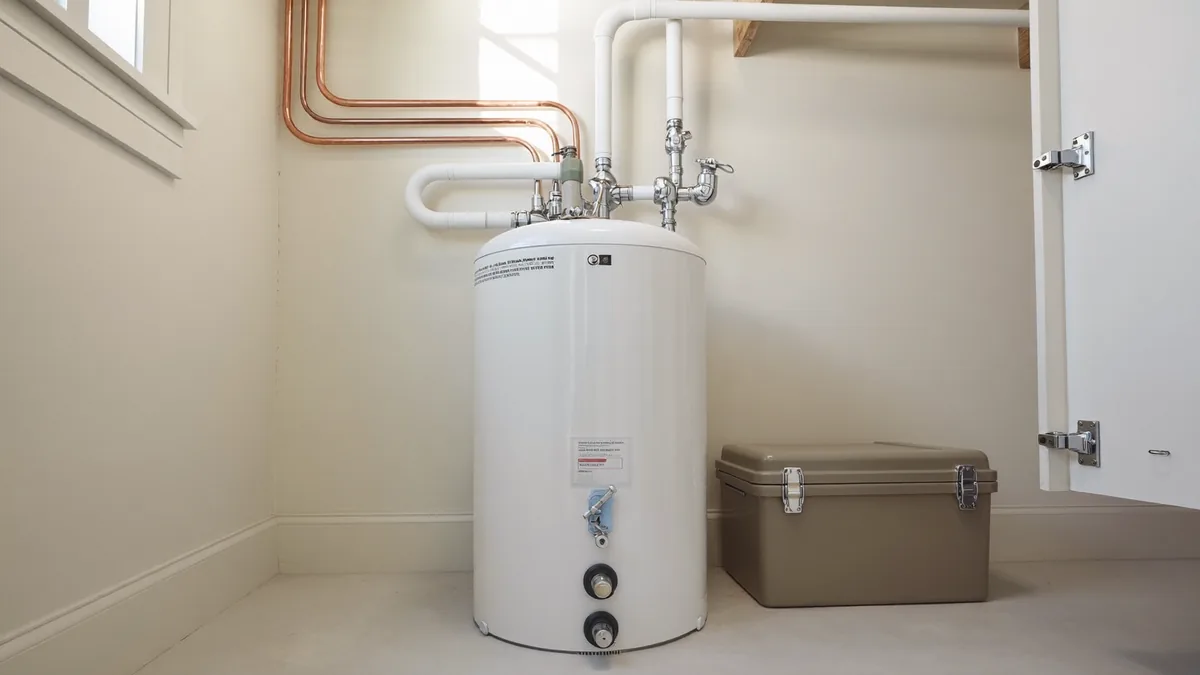
The water heater replacement cost you pay depends less on the tank than on everything around it: unit type and capacity, labor, permits, hauling away the old unit, and code upgrades such as an expansion tank, venting, or new gas or electrical work. Two written quotes for the same house can differ for these reasons alone.
The parts that make up the price
A written quote usually bundles several separate costs into one total. Some are the equipment itself, and others are the work needed to connect that equipment safely to your water, gas or electrical supply. Once you can see each part, a quote that looks high or low becomes easier to understand.
- Equipment: the water heater unit and any accessories included with it, such as valves or connectors.
- Labor: draining and disconnecting the old unit, setting and connecting the new one, and testing it before you use it.
- Permits and inspections: fees and any inspection the job requires, where your area requires them.
- Haul-away: removing and disposing of the old tank.
- Code and connection upgrades: items the new installation must meet that the old one may not have, such as an expansion tank, drain pan, venting, gas line or electrical work.
- Conversions: changing the fuel type or moving from a tank to a tankless unit, which usually adds piping, venting or electrical changes.
Unit type and capacity: what the equipment changes
The cost of new water heater equipment depends on the type, capacity and efficiency you choose. A storage tank holds heated water and reheats it as needed. A tankless unit heats water on demand, so its sizing, venting and connections differ from a tank.
Capacity is not just a number of gallons. The federal test procedure gives two ratings that help you compare units:
- First-Hour Rating: the estimate of the maximum volume of hot water a storage water heater can supply within an hour, starting fully heated.
- Maximum GPM: the maximum gallons per minute of hot water a tankless unit can supply.
Use these ratings against how your household actually uses hot water. According to the U.S. Department of Energy, federal maximum flow rates are 2.5 gallons per minute at 80 psi for showerheads and 2.2 gallons per minute at 60 psi for lavatory and kitchen faucets. A quote that sizes the unit without asking how many fixtures run at the same time deserves a follow-up question.
Efficiency is measured by the Uniform Energy Factor (UEF), which is the measure of a water heater's overall efficiency. Higher-efficiency models often carry a higher equipment price, so compare UEF values only across units of the same type.
| Type | Typical lifespan (DOE) | What tends to move the cost |
|---|---|---|
| Storage tank | 10 to 15 years | Capacity, fuel type, venting, and whether the existing space fits the new tank |
| Tankless | More than 20 years | Gas or electrical capacity, venting, water line changes, and the flow rate you need |
For more detail on tankless pricing, read our companion guides on tankless water heater cost and heat pump water heater cost. Those guides cover the equipment differences that show up on a quote.
Labor, removal and haul-away
Labor covers more than the swap itself. The installer drains the old tank, disconnects the gas or electrical supply, sets the new unit, connects it, checks for leaks and confirms it heats properly.
Access changes the time required. A unit in a tight closet, a low-ceiling basement or an attic takes longer than one in an open garage. Ask whether labor appears as its own line so you can see what it covers.
The old tank is heavy and may need to be drained, carried up or down stairs, and taken to a disposal site. Ask whether the quote includes haul-away or whether you are expected to arrange disposal yourself.
Permits and inspections
Many jurisdictions require a permit to replace a water heater, and some require an inspection once the work is done. Fees, and whether the installer or the homeowner pulls the permit, vary by city and county.
Check with your local building department before you hire anyone, and ask each bidder to state who pulls the permit and whether the fee is included. A quote that leaves permits out entirely can add a cost you did not plan for, so ask about it directly. Permit questions are also a good time to confirm the cost to replace water heater equipment in your area includes an inspection, if one is needed.
Code upgrades that add to the total
Code upgrades are the items a new installation must meet. They are often the main reason two quotes for the same tank differ. Requirements vary by location, so ask each installer which items apply to your home.
- Expansion tank: a closed water system, often one with a check valve or pressure-reducing valve, may need an expansion tank to absorb water that expands as it heats.
- Drain pan: a pan with a drain line may be required when the heater sits above finished floors or living space, so that a leak does not spread unseen.
- Venting: gas units need a vent that is sized and routed to carry exhaust out of the home. An older vent may need replacing, and tankless units often need specific venting materials.
- Gas line: a new unit with a different input rating may need a larger gas line or a new shutoff valve.
- Electrical: electric units need a circuit of the correct size and a disconnect, and an older electrical panel may need work to support the load.
- Strapping: in some areas the tank must be secured to the wall. Ask whether your area requires it.
Conversions: gas to electric and tank to tankless
Changing fuel type or unit style usually costs more than a like-for-like swap, because the piping, venting and electrical supply may all change. The more the new system differs from the old one, the more the quote tends to include.
A gas-to-electric conversion may need a new circuit, changes to the electrical panel, and removal or capping of the old gas venting. A tank-to-tankless conversion often needs new venting, a gas line sized for a higher burner input or added electrical capacity, and a location with suitable water lines. Ask for these items as separate lines so you can see what the conversion adds.
Operating costs change the long-term picture
According to the U.S. Department of Energy, water heating is about 18% of a home's energy use. Because the unit runs every day, its operating cost matters as much as its purchase price when you compare options.
The U.S. Energy Information Administration reports an average residential electricity price of 18.19 cents per kWh (January to August 2026 average). It also reports an average residential natural gas price of $15.34 per thousand cubic feet in 2025, about $1.48 per therm. Use your own utility bills to estimate running costs, since these averages give only a rough baseline.
Incentives and rebates: check the current rules
Federal incentives have changed, and the status is different for 2026 installations. The figures below were checked on official sources on November 19, 2026.
- 25C Energy Efficient Home Improvement Credit (IRS): up to $2,000 a year for heat pump water heaters, and up to $600 for qualifying gas, propane or oil water heaters. It applied only to property placed in service before December 31, 2025, so it does not apply to 2026 installations.
- 25D Residential Clean Energy Credit (IRS): 30%, including solar water heaters. It is not available for property placed in service after December 31, 2025.
- DOE Home Electrification and Appliance Rebates (HEAR): run by states and available only in select states. Up to $1,750 for an ENERGY STAR heat pump water heater, for households with income below 150% of area median income. Since DOE Program Notice 26-2 (effective May 29, 2026), these rebates no longer cover replacing a gas (non-electric) appliance, only electric-to-more-efficient-electric upgrades.
Check your state energy office and your utility for current programs. Confirm the federal details on the official IRS and DOE websites before you plan a purchase around any credit or rebate.
How to compare written quotes
Comparing quotes works best when every bidder prices the same job. Ask each one for the same unit type, capacity and efficiency rating, then line the quotes up side by side.
- Get at least two written quotes for the same scope of work.
- Confirm that each quote lists the same first-hour rating or maximum GPM and the same UEF.
- Look for separate lines for equipment, labor, permits, haul-away and code upgrades. A single lump sum hides what you are paying for.
- Ask who pulls the permit, whether the fee is included, and whether an inspection is part of the price.
- Confirm whether the quote covers removal of the old unit, plus any expansion tank, drain pan, venting, or gas or electrical work the job needs.
- Ask what the warranty covers, who handles parts and who handles labor, and whether you must register the unit yourself.
- Check the contractor's license with your state licensing board where licensing applies, and ask for proof of insurance.
When to bring in a professional
Safety first: if you smell gas, leave the home and call the gas utility or 911 from outside. Do not operate switches or light anything inside until the gas company confirms it is safe.
Gas connections, venting and electrical circuits should go to a licensed professional, and the written quote should name who performs that work. The U.S. Consumer Product Safety Commission (CPSC) recommends carbon monoxide alarms on every level of the home and outside sleeping areas, which is worth checking whenever a gas unit is replaced.
Planning ahead to avoid an emergency bill
A planned replacement costs less to manage than an emergency one. When you have time to collect quotes, you can compare scope, schedule the work, and confirm permits before the old tank fails.
- Note the age of your unit. According to the U.S. Department of Energy, most storage tank water heaters last 10 to 15 years, so a tank in that age range deserves a quote before a leak appears.
- Take photos of the gas line, venting, shutoff valves and electrical panel. These help installers quote accurately.
- Ask about any drain pan or expansion tank requirement now, so you know whether it applies to your setup.
Set the water heater to 120°F, which the Department of Energy describes as a temperature considered safe for most of the population. People with a compromised immune system or chronic respiratory disease may want to keep it at 140°F. Scalding is the risk to watch: according to the CPSC, third-degree burns occur after about 2 seconds at 150°F, 6 seconds at 140°F, 30 seconds at 130°F, and can occur after 5 minutes at 120°F.
Frequently asked questions
Why do written quotes for the same water heater differ so much?
Quotes often differ because they cover different scope. One may include haul-away, permits and code items such as an expansion tank or drain pan, while another leaves them out or lists them as extras. Make sure every bid uses the same unit type, capacity and efficiency rating, and ask each installer to itemize equipment, labor, permits and upgrades so you can compare the lines side by side.
Can I still claim a federal tax credit for a water heater installed in 2026?
Probably not under the federal credits covered here. According to the IRS, the 25C credit applied only to property placed in service before December 31, 2025, and the 25D credit is not available for property placed in service after that date. State-run HEAR rebates may still apply in select states, but they no longer cover replacing a gas appliance. Confirm the current rules on the official IRS and DOE websites.
Do I need a permit to replace a water heater?
The answer depends on your city and county, so there is no single rule that covers every address. Many jurisdictions require a permit for replacement, and some require an inspection afterward. Your city or county permit office can tell you what applies to your property, and you should ask each installer who pulls the permit and whether the fee is part of the quote.
Does a heat pump water heater cost more to replace than a gas tank?
Heat pump and gas tank quotes differ in what they must include. A heat pump unit runs on electricity, so the work centers on the electrical supply and enough space around the unit, while a gas tank centers on the gas line and venting. Ask each bidder to price its own scope, and check whether state rebates apply, since they cover electric-to-more-efficient-electric upgrades only.
How long should a new water heater last?
According to the U.S. Department of Energy, most storage (tank) water heaters last 10 to 15 years, while tankless water heaters can last more than 20 years. Your unit's actual life depends on water quality, maintenance and how hard it works. Start collecting quotes as a tank approaches the upper part of its range, so you are not forced into an emergency purchase when it fails.