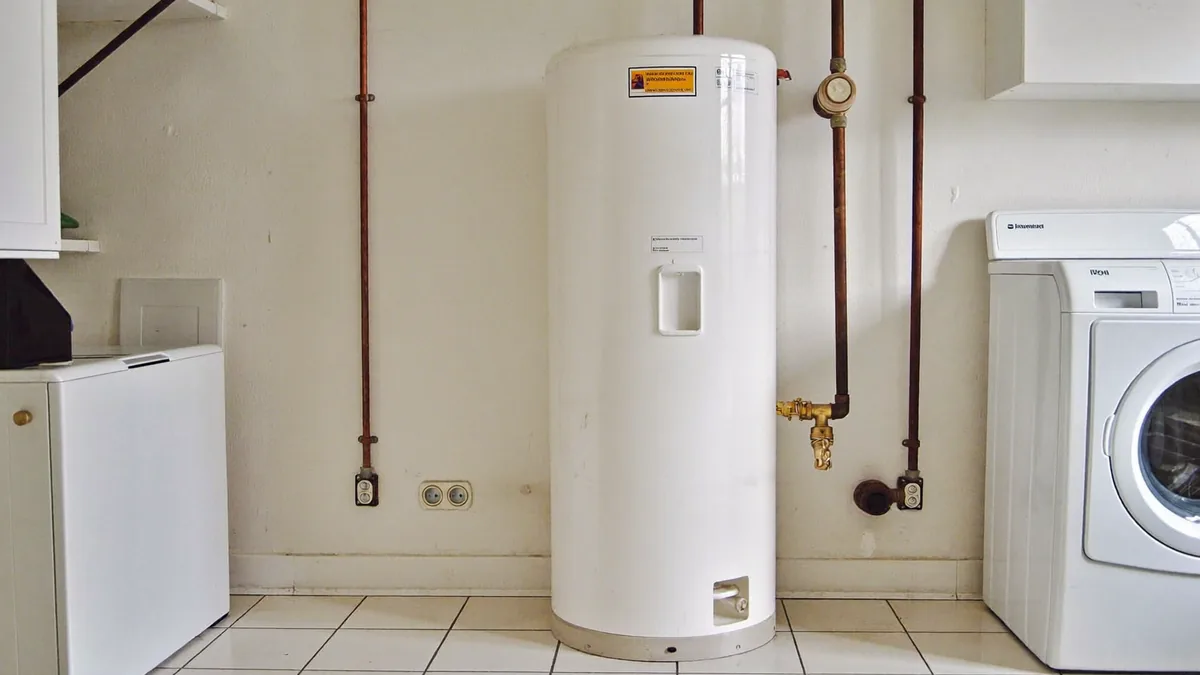
What size water heater do I need? For a storage tank, match the First-Hour Rating on the unit's label to the hot water your household uses in its busiest hour. For a tankless unit, add up the flow rate of the fixtures used at the same time, then check that the unit can supply it at your temperature rise.
What Size Water Heater Do I Need? Start With Your Hot Water Use
Sizing starts with how your household actually uses hot water, not with the gallons printed on the tank. A couple who works from home and a family of five can need very different capacity from the same model. The goal is to cover your heaviest period of the day without paying for capacity you never use.
Use the water heater size calculator on this site to total your fixtures and draws, then compare the result with the rating on the unit you are considering. The sections below explain what each rating means and how to check it.
Why Gallons on the Label Can Mislead
A tank's capacity in gallons describes how much water it holds, not how fast it can deliver hot water. Two tanks of the same size can perform differently because recovery depends on the heat input and the design of the unit. That is why the rating, not the nameplate gallons, is the number to compare.
The federal test procedure in 10 CFR 430, Appendix E, defines the First-Hour Rating as an estimate of the maximum volume of hot water a storage water heater can supply within an hour, starting from fully heated. For tankless units, the matching figure is the Maximum GPM, the maximum gallons per minute (GPM) of hot water the unit can supply. Both come from standardized testing, so they give you a fair basis for comparison.
Sizing a Storage Tank by First Hour Rating and Peak-Hour Demand
The peak-hour method asks how much hot water your household draws during the busiest single hour of a typical day, often the early morning. You then choose a tank whose First-Hour Rating meets or exceeds that total. Work through it this way:
- List every hot water use in that hour, including showers, baths, sinks, the dishwasher, the washing machine on a hot setting, and any cleaning jobs.
- Estimate the hot water each use draws. For a shower, multiply the showerhead's flow rate by the minutes it runs. Federal maximums for new showerheads are 2.5 gallons per minute at 80 psi, so a shower at that rate draws up to that amount of mixed water, with the hot share depending on how you mix it.
- Add the estimates together. This total is your peak-hour demand.
- Compare that total with the First-Hour Rating on the unit's label, and choose a unit that meets or exceeds it.
- Check the result against your habits. A new baby, a growing teenager or a guest room with a shower can change the number over time.
Two mistakes cause most undersized tanks. The first is comparing your demand with the tank's gallons instead of its First-Hour Rating. The second is leaving out the dishwasher or washer, which draw hot water during the same busy period.
Sizing a Tankless Unit by Flow Rate and Temperature Rise
A tankless unit heats water as it flows, so it does not run out the way a tank does. Its limit is how much water it can heat per minute to the temperature you need. Two numbers drive the choice: required flow and temperature rise.
Temperature rise
Temperature rise is the desired hot water temperature minus the incoming water temperature. Cold incoming water has a bigger gap to close, so the rise is larger and the unit's flow falls. Find out your incoming water temperature by season, and use the rise at which the manufacturer lists its Maximum GPM.
Required flow
Required flow is the sum of the fixtures used at the same time, in gallons per minute. If you do not know your fixtures' flow rates, use the federal maximums as a starting point: 2.5 GPM for a showerhead at 80 psi and 2.2 GPM for a lavatory or kitchen faucet at 60 psi. Older fixtures can flow faster, so measure them if you want an exact figure. Time how long a one-gallon container takes to fill at the tap, then convert that time to gallons per minute.
Water Heater Sizes Compared by Method
The two methods use different inputs and different ratings, so compare each unit against the right number.
| Step | Storage tank | Tankless unit |
|---|---|---|
| What you add up | Hot water drawn during the busiest hour | Flow rate of fixtures used at the same time |
| Rating to compare | First-Hour Rating on the label | Maximum GPM at your temperature rise |
| Common error | Comparing with tank gallons | Using a rating taken at a smaller rise |
Two Household Examples (Illustrations Only)
The numbers in these examples are hypothetical and chosen to show the method. Replace them with your own counts and the ratings from the unit's label or specification sheet.
Example A: storage tank for a family of four
Suppose the busiest morning hour includes two showers, a sink, and the dishwasher, and your estimate of hot water drawn comes to about 60 gallons. You would look for a tank whose First-Hour Rating is at least 60 gallons, not one that merely holds 60 gallons. A larger tank with a low rating can still run short during that hour.
Example B: tankless unit for a shower and a kitchen faucet
Suppose a shower at 2.5 GPM and a kitchen faucet at 2.2 GPM run at the same time. The required flow is 4.7 GPM. If incoming water is 50°F and you want 120°F at the tap, the temperature rise is 70°F, so you need a unit whose Maximum GPM at a 70°F rise is at least 4.7 GPM.
If the same unit is rated only at a smaller rise, its output at 70°F will be lower than the headline number. Read the full specification table rather than the figure on the front of the box.
Common Sizing Mistakes to Avoid
- Sizing for an average day instead of the busiest hour, which leaves you short on the mornings that matter most.
- Forgetting appliances that draw hot water, such as the dishwasher and washer.
- Assuming a tankless unit's rating applies to winter water without checking the rise it was tested at.
- Raising the setting to make up for a shortfall, which increases scald risk and also changes the temperature rise a tankless unit must deliver.
Set a Safe Temperature Before You Finalize the Size
The U.S. Department of Energy (DOE) recommends setting a water heater to 120°F, a temperature it considers safe for most of the population. According to the U.S. Consumer Product Safety Commission (CPSC), third-degree burns can occur after about 2 seconds at 150°F, 6 seconds at 140°F, and 30 seconds at 130°F, and can occur after 5 minutes at 120°F.
Safety first: Hot water can cause serious scalds in seconds. Check the temperature at a tap with a thermometer, and keep bath water at a safe level for children and older adults. If someone in the home needs a higher setting, ask a licensed plumber about point-of-use mixing valves at the fixtures.
The DOE also notes that people with a compromised immune system or chronic respiratory disease may want to keep the setting at 140°F. Your temperature choice affects sizing, so settle it before you compare units.
How Long the Unit Should Last and When to Replan
According to the DOE, most storage tank water heaters last 10 to 15 years, while tankless water heaters can last more than 20 years. If your current tank is near the end of that range, size the replacement for the household you expect over the next decade, not only the one you have today. Note any changes to bathrooms, occupants or appliances before you shop.
Efficiency, Rebates and Credits to Check Before You Buy
The Uniform Energy Factor (UEF) measures overall efficiency, not capacity. A higher UEF does not mean more hot water in the busiest hour, so use it to compare efficiency only after the size is confirmed. ENERGY STAR sets minimum UEF levels by type, including 0.95 for gas tankless units.
As of the November 19, 2026 check of official sources, the IRS 25C Energy Efficient Home Improvement Credit applied only to property placed in service before December 31, 2025, so it does not apply to 2026 installations. The 25D Residential Clean Energy Credit, which included solar water heaters, is not available for property placed in service after December 31, 2025. Confirm current status on the IRS website.
DOE's Home Electrification and Appliance Rebates (HEAR), run by states, are available only in select states. Where offered, they provide up to $1,750 for an ENERGY STAR heat pump water heater for households with income below 150% of area median income. Since DOE Program Notice 26-2 (effective May 29, 2026), these rebates no longer cover replacing a gas (non-electric) appliance, only electric-to-more-efficient-electric upgrades. Check your state energy office and your utility's website for current programs, since utility rebates vary.
Confirming the Size With a Pro
Your calculation is a strong starting point, but a site visit confirms what the numbers cannot, such as gas supply capacity, venting and the space available. Get at least two written quotes that list the same unit size and the same work. Check the contractor's license with the state licensing board where licensing applies, and ask who pulls permits. Codes vary by state and city, so check with your local building department about any requirement.
Ask each company what is included: haul-away of the old unit, any code upgrades, and warranty registration. This site does not perform installations, so treat any listed company as a starting point for your own checks.
Frequently asked questions
Is a bigger tank always better?
Not necessarily. A larger tank only helps if its First-Hour Rating covers your busiest hour, so compare the label rating with your peak-hour total first. If the rating already meets your demand, extra capacity adds little. Oversizing can also mean more standby heat loss, which is worth weighing against the occasional extra gallons.
Why does my tankless unit run short of hot water in winter?
Winter incoming water is colder, so the unit must add a larger temperature rise to reach the same setting. Because output falls as the rise grows, the unit can deliver less flow than it did in summer. Check the Maximum GPM listed at the higher rise, and confirm whether your fixtures running together exceed that number.
Should I keep my water heater at 120°F or 140°F?
The DOE recommends 120°F as a temperature it considers safe for most people. It notes that people with a compromised immune system or chronic respiratory disease may want 140°F. If you choose 140°F, protect bathers from scalds with mixing valves at the fixtures, and discuss your household's needs with a health care provider.
How long should a new water heater last?
According to the DOE, most storage tank water heaters last 10 to 15 years, while tankless water heaters can last more than 20 years. Lifespan depends on water quality, maintenance and how hard the unit works. Plan your replacement and size around that window, and account for household changes you expect during it.
What does UEF tell me about sizing?
The Uniform Energy Factor measures overall efficiency under standard test conditions. It says nothing about whether a unit will supply enough gallons in your busiest hour. Use the First-Hour Rating or Maximum GPM to confirm size, and then use UEF to compare energy use between units that fit.