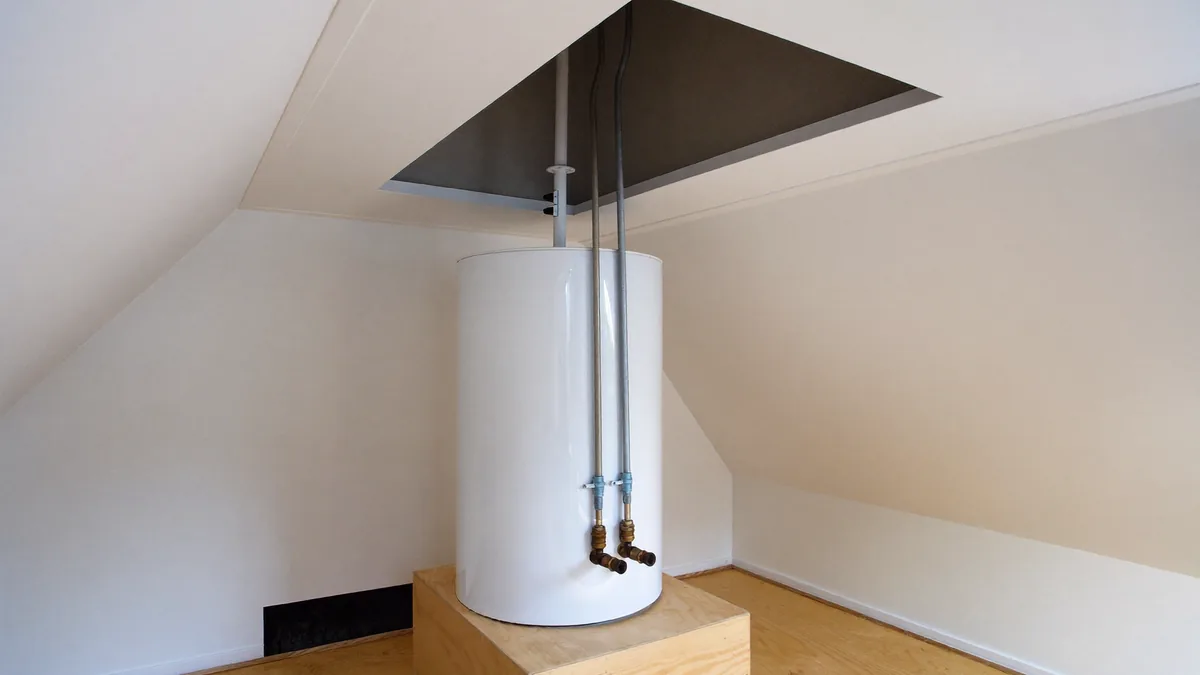
An electric water heater warms water with resistance elements or a heat pump, and the main choices are standard tanks, heat pump tanks and electric tankless units. Before you buy, match the First-Hour Rating or Maximum GPM to your household, confirm the circuit the unit needs, and compare its Uniform Energy Factor against ENERGY STAR minimums.
How an electric water heater works
Every electric water heater has a heat source, a control system and a way to deliver hot water. In a standard tank, the heat source is one or two resistance elements inside the tank. Electricity passes through each element and warms the water around it, while a thermostat decides when power goes on and off.
Elements and thermostats
Most electric tanks have an upper and a lower element, each paired with its own thermostat. The upper thermostat generally controls the lower element, so the top of the tank heats first. Lukewarm water, or hot water that runs out sooner than it used to, can point to a failed element or thermostat, and it is worth testing both before you assume the tank itself is finished.
Standard electric resistance tanks
A standard electric resistance tank is the most familiar type. It stores heated water in an insulated tank and uses elements to bring that water up to the set temperature. Its purchase price is usually the lowest of the three types, and it has few moving parts to service.
According to the U.S. Department of Energy, most storage (tank) water heaters last 10 to 15 years. Resistance tanks are also the type that can stay in the market under the federal efficiency rules, which is covered in the efficiency section below.
Heat pump water heaters
A heat pump water heater does not make heat directly. It uses a refrigeration cycle to move heat from the surrounding air into the water, which is why it uses less electricity to heat the same amount of water than a resistance tank does. Its efficiency depends partly on the room where it sits, so a larger, unconditioned space works better than a tight closet.
Heat pump models need clearance for airflow, a place for condensate to drain, and enough room air volume to work well. They also cool and dehumidify the air around them and make some operating noise. Two common configurations are an integrated unit, where the heat pump and tank form one package, and a split system, where the components are separate.
Electric tankless water heaters
An electric tankless water heater, sometimes called an on-demand unit, heats water as it flows through the unit. It does not keep a tank full of hot water, so it takes up less floor space and can be placed close to a fixture. Its capacity is rated in gallons per minute (GPM), not in gallons held.
According to the U.S. Department of Energy, tankless water heaters can last more than 20 years. Electric tankless units draw a lot of power while they run, so the electrical service is often the deciding factor in whether one fits your home. Output can also drop when incoming water is very cold, which matters most in winter.
Comparing the three types
| Type | How it heats | Sizing measure | Main tradeoff |
|---|---|---|---|
| Standard resistance tank | Elements heat stored water | First-Hour Rating | Simple design, but it heats water directly from electricity |
| Heat pump tank | Moves heat from room air into water | First-Hour Rating | Higher efficiency, but needs space, airflow and a drain |
| Electric tankless | Heats water as it flows | Maximum GPM | Compact and long-lived, but demands high power at the moment of use |
Sizing: First-Hour Rating and Maximum GPM
The federal test procedure in 10 CFR 430, Appendix E, gives two measures you should compare with your household. The First-Hour Rating is an estimate of the maximum volume of hot water a storage water heater can supply within an hour, starting from fully heated. The Maximum GPM is the maximum gallons per minute of hot water a tankless unit can supply.
Your household's peak demand matters more than your average daily use. Federal maximum flow rates give a starting point for fixtures: showerheads are limited to 2.5 gallons per minute at 80 psi, and lavatory and kitchen faucets to 2.2 gallons per minute at 60 psi (DOE, 10 CFR 430.32). Your fixtures may flow less than these limits, which lowers the demand.
To estimate what you need, work through the busiest hour of a typical morning:
- List every fixture that might run at the same time, such as two showers and a kitchen sink.
- Estimate each fixture's flow rate, starting with the federal maximums above if you do not know the real numbers.
- Multiply each flow rate by the minutes it will run, then add the totals to get the gallons used in that peak period.
- Compare that total with the First-Hour Rating for a tank, or check that the tankless unit's Maximum GPM covers the flow of your two highest-demand fixtures at once.
For example, a shower running for 10 minutes at the federal maximum of 2.5 gallons per minute uses 25 gallons. Two showers at once for that time would use 50 gallons, so the tank's First-Hour Rating needs to cover that amount plus other draws.
Circuit and electrical requirements
Electric water heaters draw substantial power, and the nameplate on the unit is the first place to check what it needs. It lists the voltage and the electrical load, and the installation manual explains the required circuit, breaker size and wire size. A small 120-volt unit can run on a standard outlet, but most larger electric heaters need their own dedicated circuit.
Before you buy, have someone compare the nameplate with your electrical panel. Ask whether the panel has room for the new circuit, and whether a tankless unit's demand will need a service upgrade. Requirements differ by state and city, so check with your local building department for the wiring and permit rules that apply to your home.
Safety first: Electrical work on a water heater can cause a fatal shock. Turn off the breaker, verify that the wires are de-energized with a tester, and do not rely on a switch alone before you open the access panel.
Efficiency standards and what UEF means
The Uniform Energy Factor (UEF) is the federal measure of a water heater's overall efficiency under the test procedure. A higher UEF means the unit uses less energy to deliver the same hot water. Compare UEF values only between units of the same type and size class, because the test results reflect those conditions.
For heat pump models, the ENERGY STAR minimum UEF values are listed below.
| Heat pump category | ENERGY STAR minimum UEF |
|---|---|
| Integrated heat pump water heater | 3.30 |
| Split-system or 120-volt heat pump water heater | 2.20 |
DOE efficiency standards have applied since April 16, 2015. A DOE final rule published May 6, 2024 requires that, from May 6, 2029, larger electric storage water heaters meet heat-pump-level efficiency. A new small electric storage class of 20 to 35 gallons effective volume, for low or very-small draw, can still use electric resistance elements.
This means a standard resistance tank bought today is a legal and practical choice for many homes, but a larger resistance tank bought after the 2029 change may not be available in the same form. Check the date and the rated capacity of any model you are considering.
Federal and state incentives you should confirm
Incentives change often, so treat the following as a checkpoint, not a final answer. The facts were checked on November 19, 2026, and you should confirm each item on the official site before you commit.
- 25C Energy Efficient Home Improvement Credit (IRS): up to $2,000 a year for heat pump water heaters, and up to $600 for qualifying gas, propane or oil water heaters. It applied only to property placed in service before December 31, 2025, so it does not apply to 2026 installations.
- 25D Residential Clean Energy Credit (IRS): 30%, including solar water heaters. It is not available for property placed in service after December 31, 2025.
- DOE Home Electrification and Appliance Rebates (HEAR): run by states and available only in select states. Up to $1,750 for an ENERGY STAR heat pump water heater, for households with income below 150% of area median income.
Since DOE Program Notice 26-2 took effect on May 29, 2026, these rebates no longer cover replacing a gas (non-electric) appliance. Only electric-to-more-efficient-electric upgrades qualify. Your state energy office and your utility can tell you which programs are open in your area.
Temperature settings, scalding and Legionella
The U.S. Department of Energy recommends setting the water heater to 120°F, which it describes as a temperature considered safe for most of the population. The Consumer Product Safety Commission (CPSC) gives the same setting and notes that third-degree burns can occur after about 2 seconds at 150°F, 6 seconds at 140°F, 30 seconds at 130°F, and can occur after 5 minutes at 120°F.
According to DOE, people with a compromised immune system or chronic respiratory disease may want to keep the water at 140°F. Legionella bacteria can grow in water heaters under certain conditions, so DOE recommends a tempering (mixing) valve set to 120°F downstream of storage tanks. If you choose a higher setting, a tempering valve is the way to deliver safe water at the tap.
What to check before you buy
Use this checklist to compare models and quotes on the same basis:
- Your peak-hour demand, worked out from the fixtures you actually use.
- The First-Hour Rating for a tank, or the Maximum GPM for a tankless unit, against that demand.
- The UEF rating and whether the model meets the ENERGY STAR minimum for its category.
- The nameplate voltage and electrical load, and whether your panel has room for the circuit.
- Space, clearance and drain requirements, plus noise and temperature effects for heat pump models.
- A tempering valve, or a plan for one, if you want water hotter than 120°F.
- The warranty terms and whether registration is required.
- Current incentive eligibility, confirmed with official sources on the day you buy.
Finding a qualified installer
Get at least two written quotes that list the same model, size and scope of work, so you can compare them directly. Check the contractor's license with the state licensing board wherever licensing applies. Ask whether the quote includes permits and who pulls them, whether haul-away of the old unit is included, whether any code upgrades are priced separately, and whether the installer registers the warranty for you.
Frequently asked questions
Is a heat pump water heater a better choice than a standard electric tank?
It depends on your space, your electricity costs and whether a program covers the purchase. A higher UEF reflects less energy used to heat the same water, and the ENERGY STAR minimum for integrated models is 3.30. Heat pump units need room air, clearances and a drain, so a tight closet may not work. Compare the installed cost and the space before you decide.
How do I know what size electric water heater I need?
Start with the First-Hour Rating for a tank or the Maximum GPM for a tankless unit, then compare it with your peak-hour use. Count the showers and faucets that run at the same time, and use the federal maximums as a starting point: 2.5 gallons per minute for showerheads at 80 psi and 2.2 gallons per minute for lavatory and kitchen faucets at 60 psi. Your fixtures may flow less, which lowers the demand.
Can an electric water heater run on a standard 120-volt outlet?
Some small units run on 120 volts, and the ENERGY STAR minimum UEF for 120-volt heat pump models is 2.20. Larger units draw more power and usually need their own circuit. The nameplate and installation manual tell you what your panel must supply, so confirm that before you buy.
How long does an electric water heater last?
According to the U.S. Department of Energy, most storage (tank) water heaters last 10 to 15 years, while tankless water heaters can last more than 20 years. Water quality, maintenance and how hard the unit works all affect lifespan. If your tank is nearing the end of that range, plan the replacement before a leak forces a rushed decision.
Do federal tax credits still apply to a water heater bought in 2026?
Generally no. According to the IRS, the 25C credit applied only to property placed in service before December 31, 2025, so it does not cover 2026 installations. The 25D credit, which included solar water heaters, is not available for property placed in service after December 31, 2025. State and utility programs may still apply, so confirm them with your state energy office and utility.