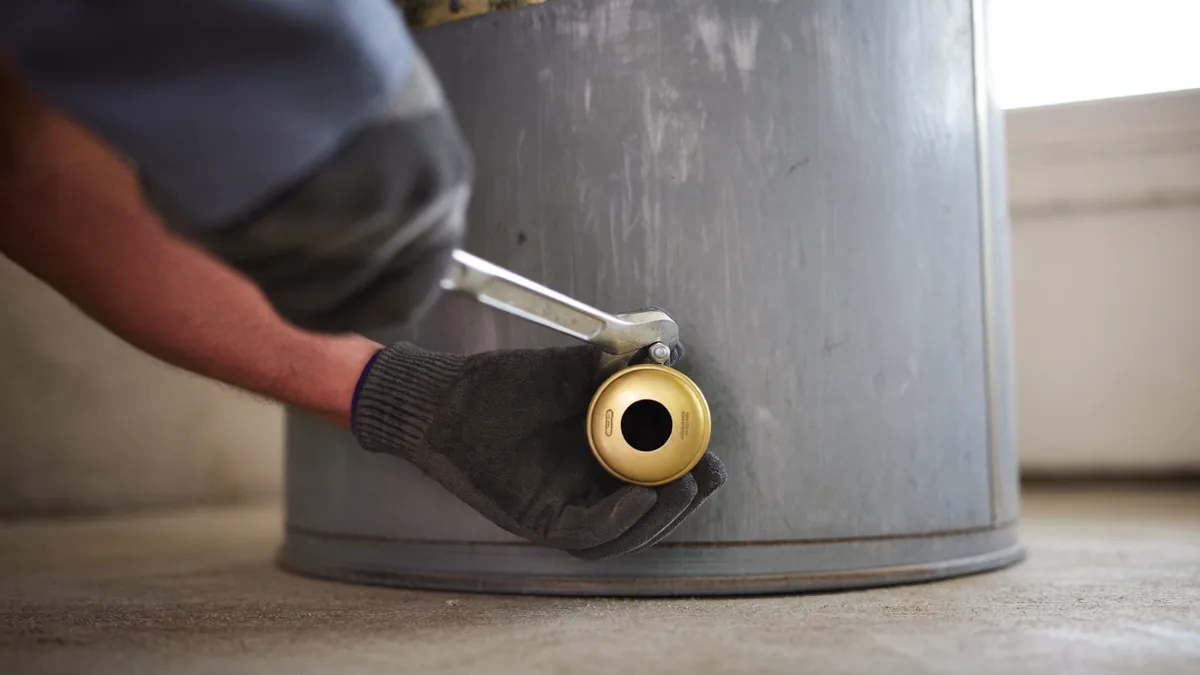
A heat pump water heater uses electricity to move heat from the surrounding air into the tank, rather than making heat directly with an electric element. It is more efficient than a standard electric tank, but it needs room for airflow, a drain for condensate, and a space that stays reasonably mild. Many models also include electric backup heat.
What a heat pump water heater is and how it moves heat
The unit works like a refrigerator, except the warm side is the one you want. A fan pulls room air across an evaporator, where refrigerant absorbs heat. A compressor raises the refrigerant's temperature, and a condenser transfers that heat into the water in the tank before the refrigerant cycles back to start again.
Because the unit moves heat that already exists in the air instead of generating it from resistance, it delivers more heat per unit of electricity. The trade-off is that its output depends on the air around it, which is why location matters.
Integrated units keep the heat pump and tank in one cabinet. Split-system units place the heat pump module apart from the tank. Some smaller units run on 120-volt household current, which is why ENERGY STAR sets a lower minimum rating for those models.
Operating modes: what the settings do
Names vary by manufacturer, so read the manual before you change defaults. Most heat pump models are hybrid water heaters that offer these common modes:
- Heat pump only: Runs only the heat pump. It gives the highest efficiency but the slowest recovery.
- Hybrid or efficiency: Uses the heat pump and switches on electric elements when demand calls for them. This suits most homes.
- Electric or standard: Uses only the electric elements, like a conventional tank. It recovers fastest and is least efficient.
- Vacation or energy saver: Lowers the setpoint or limits operation while you are away. Confirm how quickly it recovers before you return.
If you run short of hot water on a busy evening, check whether the unit is in heat pump only mode. Switching to hybrid mode usually restores recovery.
Space, airflow and condensate needs
The room needs enough air volume to supply heat without cooling the space too much. A small closet or a tightly sealed utility room can get cold quickly, which lowers performance. Keep intake and exhaust openings clear, and keep storage and laundry away from the unit.
The unit also produces condensate, the water that forms when moisture in the air condenses on the cold evaporator. It needs a drain line or pan with a route to a floor drain or another approved outlet. Without a route, condensate can pool and damage flooring.
Cooling has a seasonal side. In summer, a unit in a hot basement or garage can cool and dry that space. In winter, it pulls heat from the room, which can make a cold room colder.
Noise: what to expect
The compressor and fan make the most noise, mainly in heat pump mode. Electric operation is generally quieter. Compare the noise rating on each spec sheet, because mounting and the room's hard surfaces change how loud the unit seems.
Cold climates and backup heat
A heat pump gets its heat from the air around it, so output falls as that air gets colder. Below the air temperature range listed in the spec sheet, the unit may stop using the heat pump and rely on electric elements. That means slower recovery and higher electricity use.
A basement that stays near room temperature usually suits this technology better than an unheated garage or attic. Ask your installer how the unit will behave during your coldest months.
Efficiency standards and what the numbers mean
Efficiency is measured by the Uniform Energy Factor (UEF), defined in the federal test procedure (10 CFR 430, Appendix E) as the measure of a water heater's overall efficiency. According to the U.S. Department of Energy (DOE), water heating is about 18% of a home's energy use, so the choice matters. ENERGY STAR minimum UEF values for qualifying models are:
- Integrated heat pump water heaters: 3.30 (split-system or 120-volt units: 2.20)
- Gas storage, over 20 and up to 55 gallons: 0.81 (medium draw) or 0.86 (high draw)
- Gas storage, over 55 gallons: 0.86
- Gas tankless: 0.95
- Solar with electric backup: 3.00; solar with gas backup: 1.80
DOE efficiency standards have applied since April 16, 2015. A DOE final rule published May 6, 2024 requires that, from May 6, 2029, larger electric storage water heaters meet heat-pump-level efficiency. It also creates a small electric storage class of 20 to 35 gallons of effective volume, for low or very-small draw, that can still use electric resistance elements.
Incentives: confirm the dates before you plan
Federal tax credits
Checked on official sources on November 19, 2026: under the IRS 25C Energy Efficient Home Improvement Credit, up to $2,000 a year was available for heat pump water heaters, and up to $600 for qualifying gas, propane or oil water heaters. That credit applied only to property placed in service before December 31, 2025, so it does not apply to 2026 installations. The 25D Residential Clean Energy Credit, at 30%, is not available for property placed in service after December 31, 2025.
State and utility rebates
DOE Home Electrification and Appliance Rebates (HEAR) are run by states and available only in select states. They offer up to $1,750 for an ENERGY STAR heat pump water heater, for households with income below 150% of area median income. Since DOE Program Notice 26-2 (effective May 29, 2026), these rebates no longer cover replacing a gas (non-electric) appliance, only electric-to-more-efficient-electric upgrades.
Check your state energy office and your utility for current programs, and confirm federal rules on the official IRS and DOE websites.
Heat pump water heater pros and cons
Pros
- Much higher efficiency than resistance-only tanks, based on ENERGY STAR minimums.
- Lower operating costs in suitable spaces, especially in hybrid mode.
- Cooling and dehumidifying effect in hot, enclosed spaces.
- Electric backup elements handle heavy demand when needed.
Cons
- Needs air volume, clearance and a condensate route.
- Louder than a standard tank when the compressor runs.
- Output and recovery drop in cold spaces.
- Upfront cost is usually higher, and incentives change often.
Checking whether a heat pump water heater fits your home
- Measure the intended space, including clearance around intake and exhaust openings. Note whether it is a closet, garage or basement.
- Note the room's typical temperature range through the year. A space that gets very cold in winter may need a different location.
- Identify a condensate route, such as a nearby floor drain or a drain line that runs downhill to one.
- Review your hot water use, including showers, dishwashers and laundry. Compare the First-Hour Rating on the label, which estimates the maximum hot water a storage unit can supply within an hour starting fully heated, to your peak needs.
- Before you open any access panel or inspect wiring, turn off the breaker and verify with a tester that the circuit is dead. Then have an electrician or installer confirm the electrical service can support the unit.
- Check current state, utility and income-based rebates before you choose a model.
Water temperature, safety and Legionella
According to the DOE, 120°F is a temperature considered safe for most of the population. The DOE notes that people with a compromised immune system or chronic respiratory disease may want to keep the setting at 140°F.
Safety first: Hot water can scald quickly. According to the U.S. Consumer Product Safety Commission (CPSC), third-degree burns occur after about 2 seconds at 150°F, 6 seconds at 140°F, 30 seconds at 130°F, and can occur after 5 minutes at 120°F. Check the temperature at a faucet with a thermometer, not by touch.
Legionella bacteria can grow in water heaters under certain conditions. The DOE's Federal Energy Management Program (FEMP) recommends a tempering valve set to 120°F downstream of storage tanks, which mixes hot and cold water to keep delivered water at a safe temperature.
Finding an installer
Get at least two written quotes that describe the same scope of work. Check the contractor's license with your state licensing board where licensing applies. Ask who pulls the permit, since permit rules vary by jurisdiction, so check with your local building department. Ask each bidder what is included: haul-away of the old unit, code upgrades, condensate drain work, tempering valve and warranty registration.
Frequently asked questions
Is a heat pump water heater more efficient than a standard electric tank?
In most homes, yes. ENERGY STAR sets a minimum UEF of 3.30 for integrated heat pump water heaters, well above the 0.81 to 0.86 minimums for gas storage tanks over 20 gallons. Efficiency still depends on the room temperature and how you use the unit, so compare the UEF on each label and consider the space where the unit will sit.
Will a heat pump water heater work in a cold garage or basement?
It can work in a cold space, but output and recovery drop as the air gets colder, and the unit relies more on electric backup. An unheated garage in freezing weather is usually a poor location. A basement near normal room temperature generally suits the technology better. Check the air temperature range in the spec sheet and ask your installer how the unit will perform in your coldest months.
How loud is a heat pump water heater?
You will hear the compressor and fan most when the unit runs in heat pump mode, and it is generally quieter on electric operation. Noise depends on the model, the mounting and the room's surfaces. Compare the noise rating on the spec sheet, keep the unit away from bedrooms where possible, and avoid placing it against a wall shared with a sleeping area.
Can I still get a federal tax credit for a heat pump water heater installed in 2026?
Based on IRS rules checked on November 19, 2026, the 25C credit applied only to property placed in service before December 31, 2025, so it does not apply to 2026 installations. The 25D credit is not available for property placed in service after December 31, 2025. Confirm these rules on the official IRS website before you plan the purchase, and check state and utility rebates separately.
Does a heat pump water heater need a tempering valve?
The DOE recommends a tempering valve set to 120°F downstream of storage tanks, because Legionella bacteria can grow in water heaters under certain conditions. A heat pump water heater is a storage tank, so the recommendation applies. Ask your installer whether a tempering valve is included in the quote and where it will be placed.