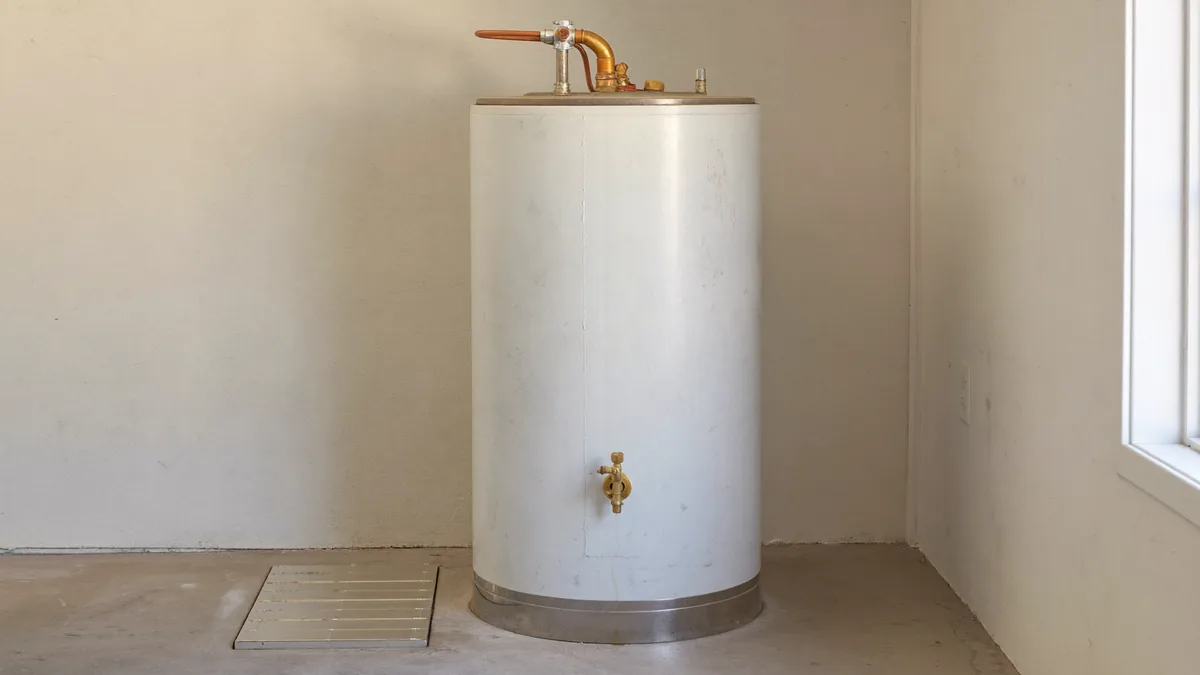
A water heater leaking from top usually traces back to the cold inlet, the hot outlet, the temperature and pressure (T&P) relief valve, or the anode rod port. Loose or worn fittings at these spots are often something you can check and snug up yourself. A leak from the tank body itself needs a plumber.
What a Water Heater Leaking From Top Usually Means
Water that shows up at the top of a tank does not always start there. Water runs downhill along pipes and the tank jacket, so a drip near the floor may have begun at a fitting several inches higher. Start at the top and follow the wet path back to its first wet point.
Condensation is a common mix-up. A cold supply line or the top of a tank can sweat in a humid room, and the moisture can look like a leak. Dry the area thoroughly, then check again after the surfaces have stayed dry for a while. If water reappears at one specific fitting, that fitting is your suspect.
Locating the Source of a Top Leak
Cold Inlet and Hot Outlet Connections
Most tanks have two pipes entering from the top: the cold water inlet, which feeds the tank's dip tube, and the hot water outlet that carries hot water to the house. Each connects through a threaded nipple or union, and sometimes a flexible connector. Leaks here often appear as drips or a crusty mineral ring around the threads.
Dielectric Nipples
Where a steel tank connects to copper pipe, a dielectric nipple (a fitting with a plastic or rubber barrier) keeps the two metals from touching directly. That separation slows galvanic corrosion, which can eat through a fitting over time. A corroded or cracked dielectric nipple is a common cause of a top leak, and the fix is replacing the nipple, not tightening it harder. Overtightening can crack the barrier and make the leak worse.
The T&P Relief Valve
The temperature and pressure relief valve is a safety device. It opens if the water gets too hot or the pressure climbs past its rating. A little weeping can mean the tank is running hot or pressure is building in the system, or that the valve is wearing out. Check the temperature setting before assuming the valve is the problem.
The Anode Rod Port
The anode rod is a sacrificial metal rod that draws corrosion away from the tank lining. It screws into a port on the top of the tank, and a worn seal or loose rod can leak there. Leaks from this port are often slow and show up as a stain or drip around the hex head.
Safe Checks Before You Tighten Anything
Before you touch a fitting, make sure the heater is safe to work on. Look at the leak with the area dry and the unit switched off.
Safety first: Turn off power at the breaker and confirm with a voltage tester before you open any electrical cover. On a gas unit, set the gas control to pilot or off. If you smell gas, leave the home and call the gas utility or 911 from outside.
- Shut off the cold water supply valve feeding the heater.
- Open a hot tap somewhere in the house to relieve pressure in the tank and pipes.
- Place a bucket or towel under the connection. If you need the water level lower, attach a hose to the drain valve and run it to a floor drain.
- Dry the fitting completely so you can see exactly where the water comes from.
- Identify the part: check whether the nut, nipple or rod seat looks cracked, corroded or stripped.
- Snug the connection with a wrench in small turns. Stop as soon as the drip stops, and do not force it.
- Restore the cold supply slowly, then watch the fitting for drips and check it again once it has dried.
- If it still leaks, stop. Replacing a nipple, valve or anode rod is a job for a plumber.
Discharge Pipe Rules for the T&P Valve
If the relief valve is dripping, look at its discharge pipe. According to the International Code Council's summary of the International Plumbing Code (section 504.6) and the International Residential Code (section P2804.6.1), 2021 editions, a discharge pipe must:
- Avoid any direct connection to the drainage system
- End in an air gap in the same room
- Be no smaller than the valve outlet
- Be untrapped and drain by gravity
- End no more than 6 inches above the floor or a waste receptor
- Have no threaded end, and no valves or tees
- Meet the rating of 100 psi at 180°F
A temperature and pressure relief valve must never be capped or plugged, because that removes the protection it provides. Requirements can differ by state and city, so check with your local building department before you change any discharge piping.
When to Call a Plumber
Some top leaks take a gentle snug. Others need a pro. Call a plumber if:
- Water comes from the tank wall or a seam rather than a fitting
- A fitting still leaks after a light snug, or its threads look stripped or corroded
- The T&P valve drips steadily, or its discharge pipe is missing, undersized or blocked
- The anode rod port leaks and the rod or seal needs replacing
- The job involves gas line or gas valve work
- The tank is near the end of its typical life. According to the U.S. Department of Energy, most storage (tank) water heaters last 10 to 15 years.
Choosing Someone to Make the Repair
Get at least two written quotes so you can compare what each one includes. Check the contractor's license with your state licensing board where licensing applies. Ask whether permits are needed and who pulls them, and ask what the quote covers, such as haul-away of the old unit, code upgrades and warranty registration.
Preventing Top Leaks Over Time
- Look at the top of the tank during routine home checks. Catching a damp fitting early keeps a small seep from becoming a bigger repair.
- Keep the water temperature at 120°F. The U.S. Department of Energy describes 120°F as a temperature considered safe for most of the population. According to the CPSC, third-degree burns can occur after about 2 seconds at 150°F and 6 seconds at 140°F. The DOE notes that people with a compromised immune system or chronic respiratory disease may want to keep the setting at 140°F, so ask your doctor what suits your household.
- Keep flammable materials away. Never store gasoline or solvents near a gas water heater. According to the CPSC, gas water heaters made after July 1, 2003 (30, 40 and 50 gallon tank models) are built to a flammable vapor ignition resistant (FVIR) standard, and gas water heaters igniting flammable vapors had been linked to about 800 fires a year.
- Keep the relief valve and its pipe clear. Never cap the valve or route its pipe where a blockage could go unnoticed.
- Install carbon monoxide alarms. The CPSC recommends them on every level of the home and outside sleeping areas, which matters for any home with a gas appliance.
Frequently Asked Questions
Is a water heater leaking from top an emergency?
It depends on how much water there is and where it goes. A slow drip at a fitting can usually wait for a check during the day. A steady flow, water spreading across the floor, or water near electrical connections needs quick action. Shut off the cold water supply to stop the flow, then arrange a repair as soon as you can.
Why is my T&P valve dripping?
The valve may be responding to high temperature or high pressure inside the tank. Check the temperature setting first, then look at the discharge pipe for blockages or improper slope. If the valve keeps dripping after that, have a plumber test the pressure and decide whether the valve needs replacing.
Should I tighten a dielectric nipple that is leaking?
A light snug is reasonable if the threads are sound. Overtightening can crack the plastic or rubber barrier, and a corroded or cracked nipple usually needs replacing. If the nipple leaks again after a gentle snug, replacement is the better fix.
Can I cap the relief valve discharge pipe to stop the drip?
No. A temperature and pressure relief valve must never be capped or plugged. Capping it removes the safety protection it provides. Fix the cause of the discharge instead, and check the piping against the code summary and your local building department's requirements.
How long should a water heater last before a top leak becomes a replacement decision?
According to the U.S. Department of Energy, most storage (tank) water heaters last 10 to 15 years, while tankless units can last more than 20 years. If your tank is near the end of that range and a plumber finds leaks in several places, replacement often costs less than repeated repairs. Ask for written quotes to compare.