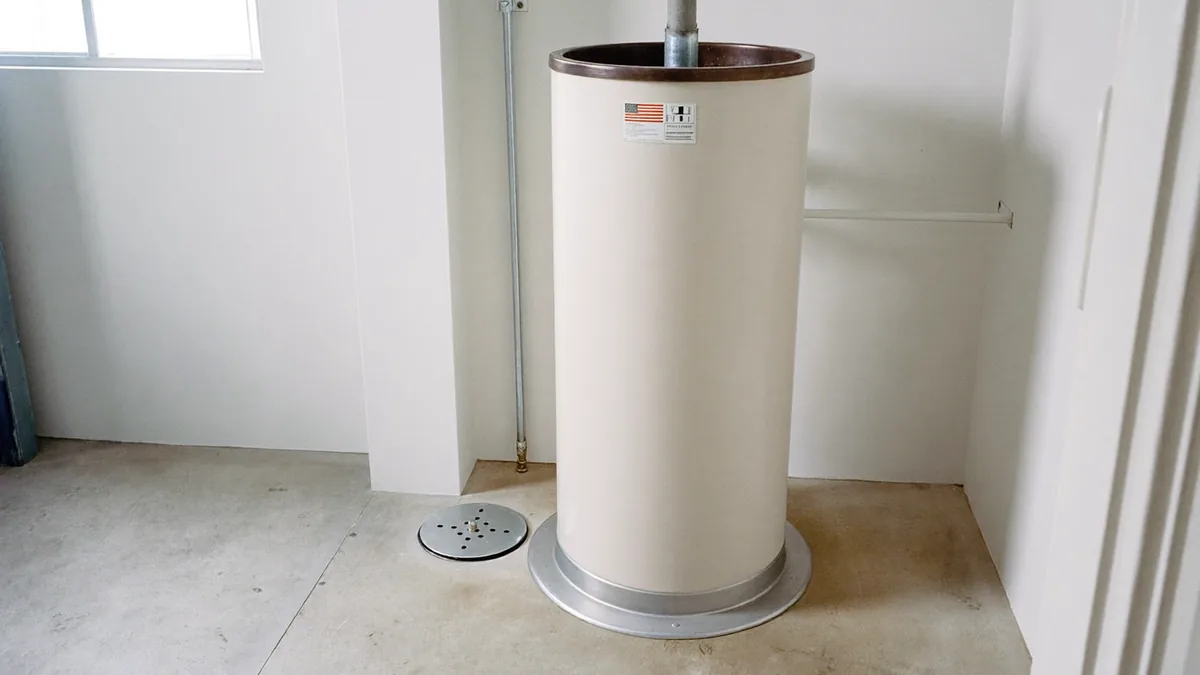
A water heater drain pan is a shallow, watertight tray placed under a tank water heater. It catches water from a leaking tank, fitting or drain valve so the water does not spread across the floor or reach the ceiling below. Whether you need one depends on where the heater sits and what your local code requires, and the right pan depends on size, material, a properly routed drain line, and optional leak detection or shut-off.
What a water heater drain pan does
A drain pan gives a leak somewhere to go besides your floor, subfloor and ceiling below. When the tank or its connections start to seep, water collects in the pan, where you have a chance to notice it and act. Without a pan, a slow leak can stay hidden under the heater for a long time while it soaks flooring and framing.
A pan contains a leak but does not stop one. It only works if water can leave the pan through a drain line, or if you catch the water before the pan overflows. Treat the pan as a backstop for damage control, not as a repair.
Where a water heater drain pan may be required
Drain pan requirements depend on your state and city, and they are not uniform. Local rules most often focus on heaters installed where a leak would do serious damage, such as in an attic, in a closet above finished living space, or on an upper floor. Some jurisdictions also set details for the pan and its drain line.
The verified information available for this guide does not include a specific code section for drain pans, so treat the points above as a starting point. Ask your local building department whether your installation location requires a pan, whether a replacement needs a permit, and what size and drain arrangement it expects. A replacement may be held to current rules, so ask before you buy equipment.
How to choose the right size and material
Choose a pan that extends past the tank's footprint on all sides, so water running down from the base or fittings lands inside it. Measure the tank diameter and the space taken up by the connections, then pick a pan that clears them without forcing the heater to sit at an angle. The pan should sit level so water pools evenly and flows toward the outlet.
Look for raised edges and enough depth to hold the water from a slow leak without spilling. Material matters because the pan sits in a damp, sometimes dirty space. Metal pans need to resist rust at the seams, and plastic pans need to stay rigid under the weight of a full tank. Confirm the outlet size matches the drain pipe you plan to use, and leave room around the heater for service and for the pipe connections.
Common sizing mistakes
- A pan that only covers the center of the tank, so water running down the side misses it.
- A pan with no outlet, which turns a small leak into a full pan that keeps soaking the base.
- A pan too shallow for the tank to sit in without touching the rim.
Routing the drain line
The pan outlet connects to a pipe that carries collected water to a visible discharge point. Use a material allowed by your local code, size the pipe to match the outlet, and run it with a continuous downward slope so water never stands in it. A low point that holds water can trap sediment and eventually block the line.
End the line where you can see it. A floor drain, a laundry sink or a spot outside the building that will not cause erosion or a hazard all work when they are reliable and visible. Avoid ending the line in a dead-end pipe, where a clog would go unnoticed.
Leak detectors and automatic shut-off valves
A leak detector is a sensor that sits in the pan. When water reaches it, the device sounds an alarm or sends a signal to your phone or a monitoring system, depending on the model. Detectors matter most when the heater is in an attic, a closet or another spot you rarely check, and when the drain line might be blocked.
An automatic shut-off valve installs on the cold water supply to the heater. When its sensor detects water, it closes the supply so the tank stops refilling. It does not drain the tank, so you still need to shut off the heater and water supply by hand once you find a leak. Both devices need power or batteries, so check them on a regular schedule.
Keep the relief valve discharge pipe separate
The temperature and pressure relief valve has its own discharge pipe, and its rules are different from the pan drain. According to the International Code Council's summary of the International Plumbing Code (section 504.6) and the International Residential Code (section P2804.6.1), 2021 editions, the discharge pipe must:
- Not connect directly to the drainage system.
- End in an air gap in the same room.
- Be no smaller than the valve outlet.
- Not be trapped, and drain by gravity.
- End no more than 6 inches above the floor or a waste receptor.
- Have no threaded end, and no valves or tees.
The valve is rated for 100 psi at 180°F. It must never be capped or plugged, because a blocked valve cannot relieve excess pressure. Local code may add requirements, so compare your setup with both the summary and your local rules.
Checking an existing pan
Before you look closely at the heater, pay attention to your surroundings. If you smell gas, leave the home right away and call the gas utility or 911 from outside. If you need to open an electrical panel or touch wiring near an electric heater, turn off the breaker and verify with a tester that the circuit is dead. Do not work on the heater if you are unsure about either.
- Look at the pan for rust, cracks, standing water, or mineral crust along the seams.
- Confirm the pan is level and the tank sits inside it without resting on the rim.
- Trace the drain outlet to its end point and confirm water can flow out and be seen.
- Check the drain line for a downward slope, low spots that hold water, crushed sections, or blockage.
- Test any leak detector using its test button or the method in its manual, and confirm the alert works.
- Confirm any shut-off valve has power or working batteries and test it as the instructions describe.
- Note the tank's age. The U.S. Department of Energy (DOE) says most storage tank water heaters last 10 to 15 years, so an older tank with a leaking pan may be near the end of its service life.
When to call a professional
Call a licensed plumber if water is coming from the tank body, if the drain line is blocked or runs somewhere it should not, or if the pan is corroded or cracked. Get help if the relief valve drips, discharges steadily, or will not seat, and if you are unsure whether the installation meets your local rules. A plumber can also tell you whether the heater location calls for a pan that you do not yet have.
Preventing leaks and damage
Set the water heater to 120°F. The DOE describes that temperature as considered safe for most of the population, and the Consumer Product Safety Commission (CPSC) recommends the same setting because third-degree burns can occur after about 5 minutes at 120°F and much faster at higher temperatures. People with a compromised immune system or chronic respiratory disease may want to keep the tank at 140°F, according to the DOE.
If you keep the tank hotter, a tempering (mixing) valve set to 120°F, installed downstream of the tank, lets the tank run hotter while limiting scald risk at the tap. The DOE's Federal Energy Management Program notes that Legionella can grow in water heaters under certain conditions, so this approach can help with both concerns. Follow the manufacturer's manual for flushing and anode inspection, and note that many manufacturers recommend flushing at least once a year.
Inspect the pan and drain line during routine checks, especially after a noisy or severe cold snap that may have stressed fittings. Keep the area around the pan clear of stored items so you can see leaks early.
Finding a pro for pan and drain work
Before you hire anyone to install a pan, add a leak detector or reroute a drain line, get at least two written quotes. Check each contractor's license with your state licensing board where licensing applies. Ask who pulls the permits, and ask what the quote includes, such as haul-away of the old unit, any code upgrades the inspector may require, and help with warranty registration.
Frequently asked questions
Is a water heater drain pan always required?
No. Requirements depend on where the heater is installed and on the rules in your state and city. Heaters in attics, closets above finished rooms, or on upper floors are the most likely to trigger a pan requirement. Ask your local building department whether your location needs one, and whether a replacement needs a permit before you buy equipment.
Will a drain pan stop a leaking water heater?
No. A pan holds water that escapes from the tank or its fittings and keeps it off the floor, but it does not repair the leak. Once you see water in the pan, find the source. A leak from a fitting may be repairable, while a leak from the tank body usually means the tank needs replacing. Shut off the water supply and call a plumber.
Where should the pan drain go?
Route it to a visible, reliable discharge point, such as a floor drain or an exterior spot where the water will not cause erosion or a hazard. The line should slope continuously downward, with no low spots that trap water, and it should not end in a dead-end pipe. Confirm the discharge point with your local code, since the rules differ by location.
Can a leak detector replace a drain pan?
In most cases, no. A detector tells you water is present, but the pan physically contains and directs it. The two work best together: the pan catches the water and the detector sounds an alert or closes the supply. Test the detector regularly, and replace its batteries when the device calls for it.
Does the relief valve need its own discharge pipe?
Yes. The temperature and pressure relief valve has a separate discharge pipe with its own rules, including an air gap in the same room, no trap, and an end no more than 6 inches above the floor or a waste receptor. Never cap or plug the valve or its outlet. If the valve drips or discharges steadily, have a plumber check it promptly.