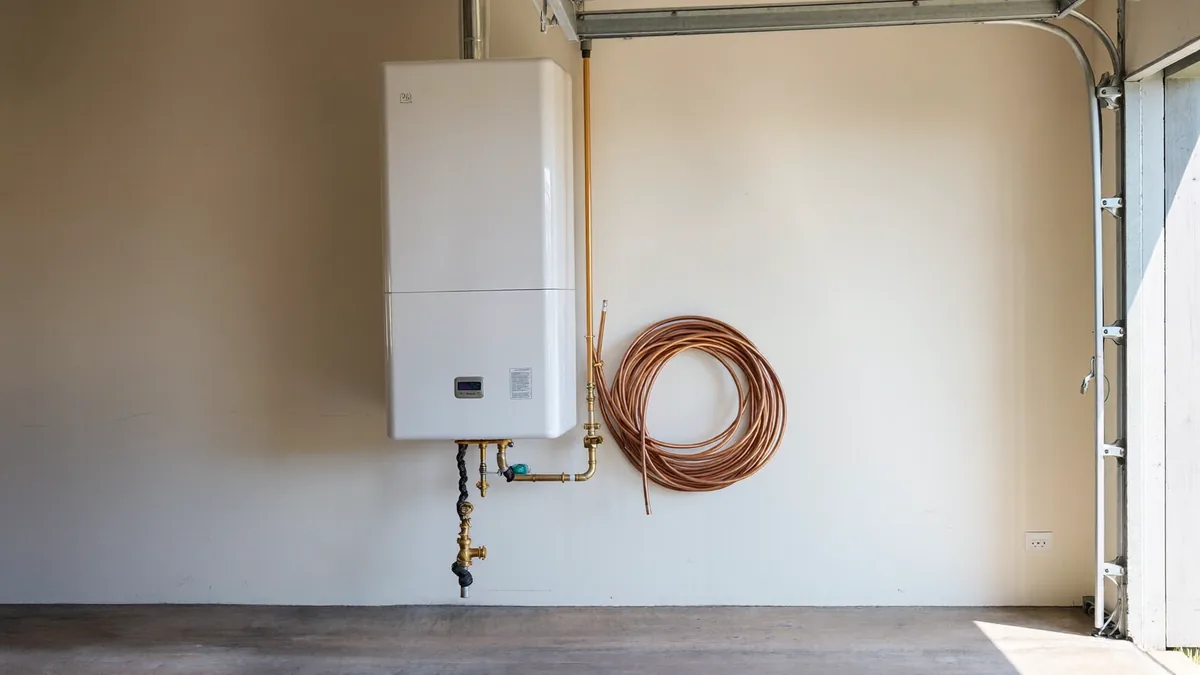
When you compare a tankless vs tank water heater, the core difference is how each unit stores and delivers hot water. A tank heater keeps a stored supply heated and ready, while a tankless unit heats water only as it flows through. The right fit depends on your peak hot water use, space, fuel type and budget.
Tankless vs tank water heater: how each handles hot water supply
A tank water heater is described by its First-Hour Rating. According to the federal test procedure (10 CFR 430, Appendix E), this is an estimate of the maximum volume of hot water the unit can supply within an hour, starting fully heated. A tankless unit is described by its Maximum GPM, the maximum gallons per minute of hot water it can supply. These ratings measure different things, so compare them against one question: will your household run out at the busiest time of day?
Storage tanks
A tank works like a reservoir. It handles a burst of demand well as long as the stored volume lasts, and then it has to reheat, which takes time. Two showers and a dishwasher running together at 7 a.m. will drain a tank faster than a single shower.
Tankless units
A tankless unit does not run out of hot water in the usual sense, but it can only deliver as much as its flow rate allows at the temperature you set. When several fixtures run at once, the combined flow can exceed the unit's Maximum GPM, and you will notice lukewarm water or a drop in output. Cold incoming water in winter also reduces how much a tankless unit can heat, so check its rating against your coldest months.
To estimate your needs, list the fixtures that might run together. According to the U.S. Department of Energy, federal maximum flow rates are 2.5 gallons per minute at 80 psi for showerheads and 2.2 gallons per minute at 60 psi for lavatory and kitchen faucets (10 CFR 430.32). Because these are ceilings, adding them gives a conservative estimate. Compare that total with the Maximum GPM in the unit's specifications.
Upfront costs and installation factors
Installation often affects the final bill more than the unit itself. A tank replacement in the same location, with the same fuel and venting, is usually the simplest job. A tankless swap can require changes to gas piping, venting, electrical service or water connections, depending on the fuel and the house. Ask each installer to evaluate these items before you compare prices.
- Gas supply: a gas tankless unit may need a larger gas line than the tank it replaces.
- Venting: gas units of both types need venting, and a tankless vent route can differ from a tank's.
- Electrical service: an electric tankless unit can draw a large amount of power, which may require circuit or panel upgrades.
- Permits: check with your local building department about permits and inspections, since requirements vary by state and city.
Incentives as of November 19, 2026
Federal incentives have changed, and some have ended. According to IRS guidance checked on November 19, 2026, the 25C Energy Efficient Home Improvement Credit (up to $2,000 a year for heat pump water heaters; up to $600 for qualifying gas, propane or oil water heaters) applied only to property placed in service before December 31, 2025, so it does not apply to 2026 installations. The 25D Residential Clean Energy Credit (30%, including solar water heaters) is not available for property placed in service after December 31, 2025.
DOE Home Electrification and Appliance Rebates (HEAR) are run by states and are available only in select states. They offer up to $1,750 for an ENERGY STAR heat pump water heater for households with income below 150% of area median income. Since DOE Program Notice 26-2 (effective May 29, 2026), these rebates no longer cover replacing a gas (non-electric) appliance, only electric-to-more-efficient-electric upgrades. Confirm current programs with your state energy office, your utility and the official IRS and DOE sites before you buy.
Efficiency: which type uses less energy?
According to the U.S. Department of Energy, water heating is about 18% of a home's energy use, so this choice matters. Efficiency is measured by the Uniform Energy Factor (UEF), which the federal test procedure describes as the measure of a water heater's overall efficiency. A higher UEF means a more efficient unit. The ENERGY STAR minimum values below show the efficiency floor for each category.
| Water heater type | ENERGY STAR minimum UEF |
|---|---|
| Integrated heat pump water heater | 3.30 (split-system or 120-volt units: 2.20) |
| Gas storage, over 20 and up to 55 gallons | 0.81 (medium draw) or 0.86 (high draw) |
| Gas storage, over 55 gallons | 0.86 |
| Gas tankless | 0.95 |
A tankless unit's higher minimum reflects that it does not keep a full tank of water hot all day, so it avoids standby heat loss. Actual savings depend on how much hot water you use and how many fixtures run at once. A household with low, steady use may see a bigger difference than one that runs several showers back to back.
Standards are also changing. Current DOE efficiency standards have applied since April 16, 2015. A DOE final rule published May 6, 2024 requires that, from May 6, 2029, larger electric storage water heaters meet heat-pump-level efficiency, while gas, oil and larger electric storage heaters get a moderate efficiency increase. A separate DOE rule for gas tankless water heaters, from December 2024, was withdrawn by Congress under the Congressional Review Act on May 20, 2025.
Space, lifespan and maintenance
Space and placement
A tank takes up floor space, usually in a utility closet, garage or basement, and needs room for service and any drain pan. A tankless unit mounts on a wall and frees floor area, which matters in small homes. Either way, check clearances, vent routes and access for future service before you pick a location.
Lifespan
According to the U.S. Department of Energy, most storage (tank) water heaters last 10 to 15 years, while tankless water heaters can last more than 20 years. Water quality, maintenance and installation quality all affect how long a unit lasts, so treat these ranges as a guide, not a guarantee. A tank approaching the end of its range is a sensible time to compare options.
Maintenance
Tanks collect sediment on the bottom, which reduces efficiency and can shorten life. Routine care includes flushing the tank on the schedule the manufacturer gives and checking the anode rod and the temperature-pressure relief valve. Tankless units need periodic descaling where water is hard, and many have an inlet filter to clean. Intervals vary by model, so follow the manual.
Legionella and temperature settings
According to the Federal Energy Management Program, Legionella bacteria can grow in water heaters under certain conditions. DOE recommends a tempering (mixing) valve set to 120°F downstream of storage tanks. The DOE Energy Saver Guide adds that people with a compromised immune system or chronic respiratory disease may want to keep the heater at 140°F. Ask your installer whether a tempering valve is part of the quote.
Safety first: set the water heater to 120°F, the temperature the U.S. Department of Energy calls safe for most of the population. The Consumer Product Safety Commission (CPSC) says third-degree burns can occur after about 2 seconds at 150°F, 6 seconds at 140°F, 30 seconds at 130°F, and after 5 minutes at 120°F. If you smell gas, leave the home and call the gas utility or 911 from outside. For electrical work, turn off the breaker and verify that the power is off before touching any wiring. The CPSC recommends carbon monoxide alarms on every level of the home and outside sleeping areas.
Power outages
Outages reveal a real difference between the two designs. An electric tank holds stored hot water that stays usable for a while, but it cannot reheat without power. Many older gas tanks with a standing pilot can keep heating during an outage, while newer models with electronic ignition usually need electricity, so check the specific unit.
Tankless units generally depend on power for their controls, and electric tankless units cannot heat at all without it. If outages are common where you live, a tank holds a reserve that a tankless unit does not, which can matter for a household that relies on hot water every morning. A generator can support a tankless unit only if its capacity matches the unit's power requirements, so confirm that in the manual.
Decision checklist
- Count peak use. List the fixtures that run at the same time and compare the total flow with the tankless Maximum GPM or the tank's First-Hour Rating.
- Measure your space. Note available floor area, wall space and possible vent routes.
- Check fuel and power. Confirm gas line size or electrical capacity before you compare quotes.
- Weigh outage risk. If outages are frequent, decide whether stored hot water or a backup plan matters more.
- Compare efficiency. Check each model's UEF against the ENERGY STAR minimums in the table above.
- Confirm incentives. Check current federal, state and utility programs against the dates in this guide.
- Plan upkeep. Be ready to flush a tank or descale a tankless unit on the schedule in the manual.
Finding and comparing installers
Once you have narrowed the type, get at least two written quotes so you can compare the scope of work, not just the total. Check the contractor's license with your state licensing board where licensing applies. Ask whether the quote includes permits and who pulls them, haul-away of the old unit, any code upgrades the new unit requires, and whether the installer handles warranty registration.
Frequently asked questions
Is a tankless water heater more efficient than a tank model?
Often, yes, when you compare the ENERGY STAR minimum UEF values. The gas tankless minimum is 0.95, while the minimum for gas storage over 55 gallons is 0.86. UEF measures overall efficiency, and a higher number means a more efficient unit. Real savings depend on how much hot water you use and how many fixtures run together, so compare the UEF of the specific models you are considering.
How long does each type last?
According to the U.S. Department of Energy, most storage (tank) water heaters last 10 to 15 years, while tankless water heaters can last more than 20 years. Lifespan depends on water quality, maintenance and installation quality. Regular flushing for tanks and descaling for tankless units help. Treat these ranges as guidance rather than a promise, and plan replacement before a failing tank causes water damage.
Will a tankless water heater work during a power outage?
Usually not fully. Tankless units generally need electricity for their controls, and electric tankless units cannot heat without power. Some older gas tanks with a standing pilot keep heating during an outage, while newer models with electronic ignition often need power. A generator helps only if its capacity matches the unit's requirements, so check the manual first.
Can I still get a federal tax credit for a water heater installed in 2026?
Generally, no, under the two main federal credits. According to IRS guidance checked on November 19, 2026, the 25C credit applied only to property placed in service before December 31, 2025, so it does not apply to 2026 installations. The 25D credit is not available for property placed in service after December 31, 2025. Some state or utility programs may still apply, so confirm them directly with the official IRS and DOE sites and your local program administrators.
Does a tank water heater need a tempering valve?
According to the U.S. Department of Energy, a tempering (mixing) valve set to 120°F is recommended downstream of storage tanks. It blends hot water with cold so the water reaching your taps stays at a safer temperature. DOE notes that Legionella can grow in water heaters under certain conditions, and people with a compromised immune system or chronic respiratory disease may want the heater set to 140°F. Ask whether a tempering valve is included in the quote.